
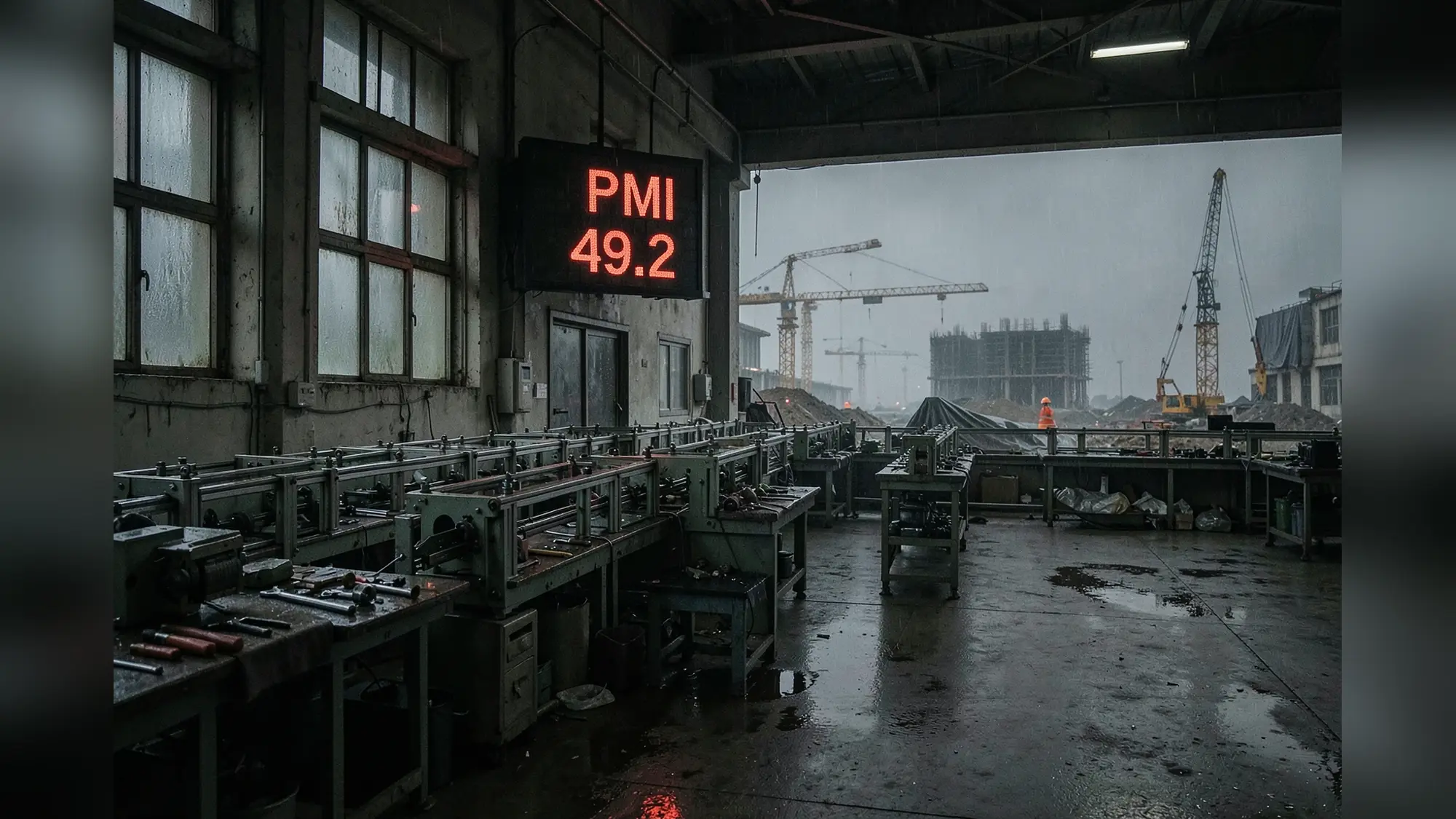
The official manufacturing PMI, compiled by the National Bureau of Statistics, slipped to 49.2 in July from 50.3 in June, moving back below the 50 line that separates expansion from contraction. New orders fell to 48.5, their weakest in 38 months, services stood at 49.3 and construction hit a record low of 47.0, leaving the composite PMI at 49.3. "Domestic weakness appears largely to blame," said Julian Evans-Pritchard, head of China economics at Capital Economics, and top leaders have pledged stepped-up fiscal support for the second half of the year.
"What the reading shows is a decline in the non-manufacturing sector's prosperity level in July," said Huo Lihui, a National Bureau of Statistics official, attributing the weakness to domestic demand and weather disruptions. Wind-accessed NBS data pointed to a recent spate of typhoons that halted project work and to the unwinding of front-loading that had buoyed output earlier in the year. The factory-gate prices subindex extended its decline, signalling continued producer price weakness.
How bad was the manufacturing slide? The fall to 49.2 is small in absolute terms but important in tone because it marks a return below 50 after June's marginal expansion. This new-orders subindex at 48.5 is the sharper signal: it shows demand weakening at a pace not seen in three years. That drop, paired with falling producer prices, implies firms face both weaker demand and narrowing margins.
Is the slowdown broad-based? Yes.
Construction registered its weakest reading on record at 47.0, while services fell to their weakest level since the initial Covid-19 lockdowns. The composite PMI logged its lowest level since 2022.
China Beige Book business surveys also reported deterioration in manufacturing employment and a general weakening of job growth across sectors.
Do private surveys tell the same story? Not entirely. The private-sector RatingDog survey returned a 50.9 reading for July, indicating modest expansion, a divergence noted in S&P Global compilation notes. That gap reflects methodological and sample differences: the official PMI samples a larger share of state-linked firms, while the private survey leans toward small and medium-sized enterprises. The two series therefore capture different slices of the economy.
What does this mean for growth and policy? The print follows official acknowledgements of "difficulties and challenges facing the economy" made at the country's mid-year meeting. Second-quarter GDP grew 4.3 percent year-on-year, the slowest pace in more than three years and below the lower bound of the official 4.5 to 5.0 percent annual target, according to NBS data and policy statements. State commentary after the meeting quoted President Xi urging leaders to "enhance the effectiveness of macroeconomic policies, focusing on tapping the potential of domestic demand."
Related Articles
- 85% Control: Why China’s Rare-Earth Grip Won’t Break
- Copper slips as China holiday reshapes positions
- China rare‑earth stocks jump up to 18% after Beijing tightens rules
Top policymakers have pledged stepped-up fiscal support for the second half of the year, the clearest signal yet that authorities intend to try to arrest the slowdown. Second-quarter GDP grew 4.3 percent year-on-year, the slowest pace in more than three years and below the official 4.5-5.0 percent annual target. Originally reported by CNBC.
This article was created with AI assistance.



