
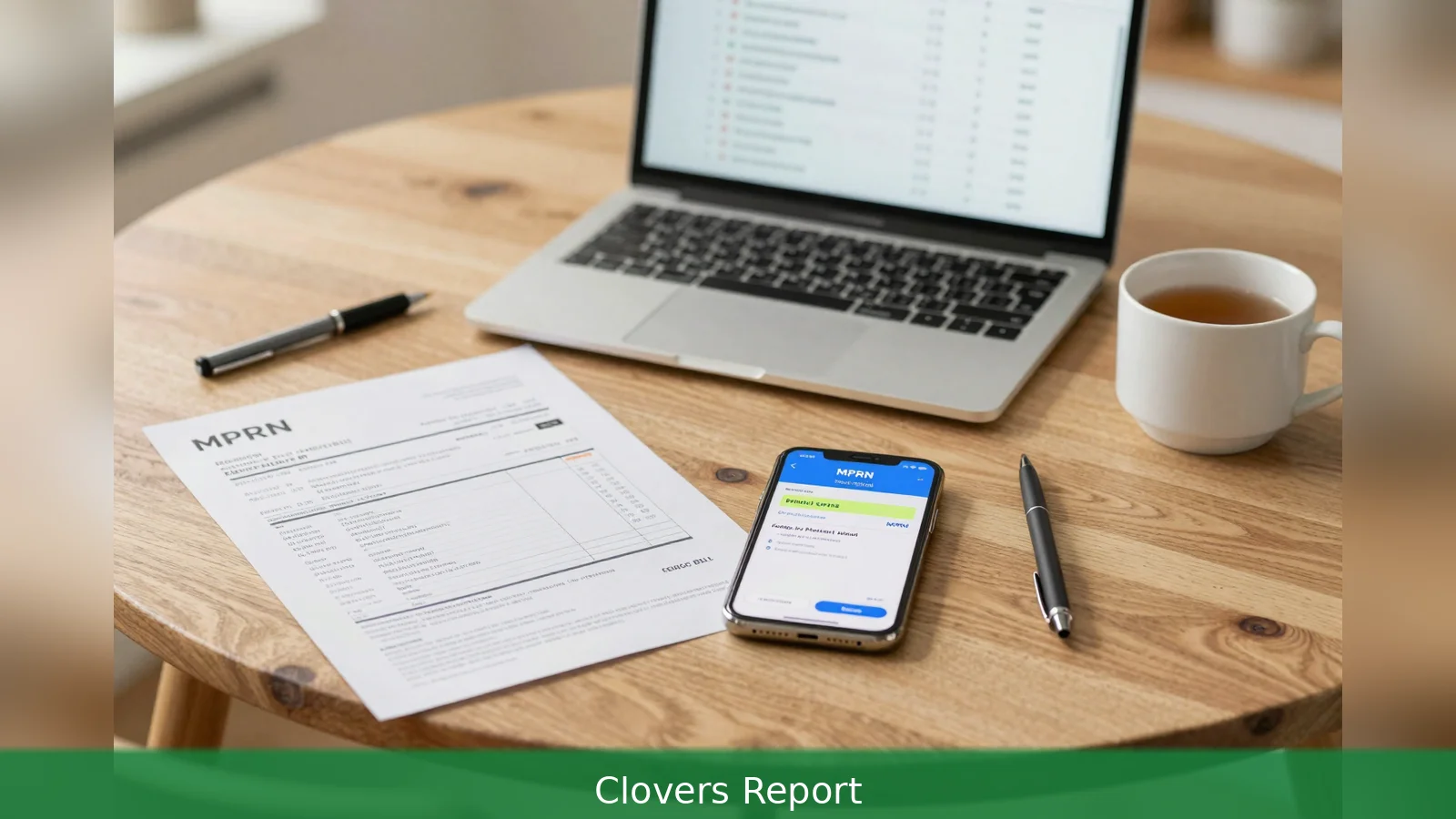
A kitchen table strewn with last month’s energy bill, a pen and a phone captures the exact starting point for shaving hundreds off household costs by switching suppliers. If you want to cut the bill, the single most effective move is simple: use a tailored comparator to find the largest new-customer discount that fits your meter type and consumption, sign up, then set a calendar reminder to switch again before that discount ends. You will need three items from your bill or account to do this accurately: your electricity Meter Point Reference Number, your Gas Point Reference Number if you have gas, and a 12-month consumption figure in kilowatt hours. Put those facts together with your meter class and whether you export solar power and you can generate an apples-to-apples annual cost estimate and complete the free switch in about two to three weeks.
Picture the same kitchen table, this time with your supplier website open and the cursor sitting in a box labelled MPRN. That's where the practical work begins. The details on that physical or PDF bill determine which supplier will actually be cheapest for your home, not the advertorial headline or the flashiest percentage off.
1. Gather the facts from your bill and devices
Start by locating your Meter Point Reference Number, often abbreviated to MPRN, and, if you have gas, your Gas Point Reference Number or GPRN. Note the billed annual consumption in kWh for electricity and for gas. If a single bill doesn't show a 12-month figure, use the rolling year total in your supplier account or the ESB Networks usage screen. ESB Networks also records whether your meter is classified as urban or rural, and that classification affects the standing charge applied, so confirm the meter type on the bill or in your ESB Networks online account.
If you have a Smart meter, you will normally see consumption split into time bands. Smart meters allow you to upload interval data to many comparator tools, which gives a much more precise estimate for time-of-use tariffs than a simple annual kWh number. If you have solar panels, note the volume you export and whether you are on any export payment scheme, because export rates alter the value proposition from one supplier to another under the Clean Export Guarantee.
For context, comparator tools often use average household figures of 4,200 kWh per year for electricity and 11,000 kWh per year for gas. Those figures are useful for comparisons across the market, but they don't replace your own consumption numbers when deciding which deal is cheapest for your circumstances.
2. Confirm your meter type and the tariff form that suits you
Look at the meter type before you trust a headline unit rate. The three common electricity meter categories to compare are: a standard 24-hour meter with a single unit rate, a NightSaver day/night meter that applies a cheaper overnight rate, and a smart meter that enables multi-band time-of-use pricing.
Smart meters are required to take full advantage of time-of-use and dynamic tariffs.
Dynamic time-of-use tariffs, which expose consumers to variable rates that can change frequently, are now available from multiple suppliers. If you aren't willing or able to shift major loads to cheaper times, a flat 24-hour tariff is usually simpler and easier to compare. For rural properties, standing charges are typically higher. Standing charges can be significant for low-usage homes and may wipe out savings from a low unit rate in those cases.
Short worked example: if you live in a rural low-usage home, a supplier offering a low unit rate but a high standing charge may cost more over the year than a rival with a slightly higher unit rate and a lower standing charge. That's why meter class is a primary input to any reliable comparator result.
3. Run tailored comparisons rather than trusting headline pricing
Use an online comparator where you can enter your meter type, MPRN or GPRN and annual consumption to generate a ranked list of plans. Good tools present annualised cost estimates that include unit rates, standing charges, VAT and levies such as the Public Service Obligation levy where applicable. Commercial comparison services and independent price lists show the cheapest supplier can differ by meter type and usage pattern. For example, in mid-June 2026 one comparator ranked a particular supplier as the cheapest for a standard 24-hour customer and a different supplier as the cheapest for customers with smart meters.
New-customer discounts are often decisive for the first year. Most providers advertise introductory discounts that typically last 12 months and can be 20 to 40% off the headline unit rate. Because those discounts frequently apply only in year one, a one-year saving can be followed by a higher bill unless you act again before the renewal step.
Another practical point: some comparator estimates quote an annual bill that excludes welcome credits, cashback or other one-off incentives. Check the small print so you know whether the lowest-cost figure for year one includes a non-recurring incentive that won't repeat in year two.
4. Compare the contract terms and the net cost beyond year one
Once you have a short list from a comparator, compare the discounted unit rate, the expected post-discount unit rate, the standing charge, contract length and whether the offer is fixed or variable. Fixed contracts typically lock the unit rate for a set period, often 12 to 24 months, and protect you from wholesale price rises for that term. Variable contracts usually allow suppliers to change rates on 30 days' notice.

If you have solar panels, compare Clean Export Guarantee rates between suppliers. A low import rate may not compensate for a poor export rate if you export a big share of your generation. Likewise, if a comparator quotes an estimated annual bill, verify whether that estimate includes or excludes any welcome credits or cashback that the supplier offers to new customers only.
Worked example: a comparator table from mid-June 2026 showed an estimated annual bill for a standard 24-hour customer with one supplier at about €1,554 per year, while another supplier led on smart-meter pricing with an estimated €1,484 per year. Those concrete figures illustrate how the cheapest option can flip between meter types. Expect rankings like these to change frequently as suppliers rotate discounts and promotions.
5. Apply to switch and understand the practical steps
When you decide, the switching process is free and your new supplier handles the administrative transfer. Expect the physical supply to remain uninterrupted. Practical lead times reported by comparators and supplier information show that switching typically takes about two to three weeks from acceptance to completion. There is a cooling-off period after signing up with a new supplier, during which you can cancel under consumer protections.
Your new supplier will ask for your MPRN or GPRN, your preferred payment method and proof of identity or bank details if you choose direct debit. If you are on prepay, the move can involve a different process and prepay tariffs tend to cost more per unit than standard credit or direct debit plans.
One more practical caution: when signing, check the supplier's standing charge classification so the invoice shows urban or rural appropriately. That classification can materially affect the annual total, particularly for low-usage households.
6. Monitor the switch and calendarise the next move
After you accept a new offer, the supplier will confirm the key dates and expected completion. Record the contract end or set a reminder at the 11-month mark, because the first-year discount rarely lasts longer than 12 months. Many independent analysts advise setting a reminder to review offers again in 11 months so you can switch before the discount expires.
When you receive your first bill from the new supplier, check the applied discount, the standing charge classification and any welcome credit. If you have a smart meter, upload or review your interval data and check whether your actual usage pattern fits the chosen time-of-use plan. If it does not, switching to a different tariff type may save more.
Repeat switching to capture new-customer discounts is a legitimate strategy under current Irish market practice. One comparator in mid-June 2026 advertised a combined potential saving of up to €688 per year when switching both gas and electricity. That kind of headline depends on meter class, consumption and whether the comparator included all one-off incentives in its calculation.
Practical cautions and consumer protections
The Commission for Regulation of Utilities doesn't fix retail prices in Ireland. Suppliers set their own unit rates and standing charges, so retail offers vary across the market. Fixed-term deals can protect you from wholesale price movements but may bind you for 12 to 24 months. Variable deals may be cheaper if wholesale costs fall, but can rise on 30 days' notice.
Prepay tariffs offer control but are generally more expensive per unit. For households with solar, the Clean Export Guarantee payment you receive for exported generation is a material component of the overall value of a chosen supplier's plan. If you export significant energy, prefer suppliers offering competitive CEG rates even if their import unit rate looks attractive.
Finally, be wary of headline savings that are tied to one-off credits or cashback. If a comparator's lowest-cost figure includes a welcome credit that only applies in year one, the effective cost in year two can be substantially higher unless you switch again.
Worked checklist and short scenarios
First scenario: you have a standard 24-hour meter, live in an urban area and use about 4,200 kWh a year. Enter your MPRN and 4,200 kWh into a comparator, note the suppliers ranked cheapest, and check which of those offers a 20 to 40% first-year discount and what the post-discount unit rate will be.
Second scenario: you have a smart meter and significant overnight usage. Upload interval data where possible and compare dynamic or time-of-use tariffs.
If you can shift high-load activities to cheaper periods, a smart-meter tariff may beat a flat-rate deal. But if you can't shift loads, a simple flat 24-hour tariff may be less risky and easier to predict.
Third scenario: you live in a rural property with low consumption. Pay particular attention to standing charges. If high standing charges apply, a low unit rate won't guarantee the lowest annual bill.
In short
First, pull your MPRN and GPRN and the 12-month kWh figures from your bill or supplier account. Second, confirm your meter class with ESB Networks and note whether you have a smart meter or export solar power under the Clean Export Guarantee. Third, use a comparator that accepts interval data, compare discounted and post-discount rates, and set a calendar reminder at 11 months so you can switch before the first-year discount expires.
Related Articles
- Best Robot Lawn Mowers 2026: choose by lawn size and layout
- Best savings account in Ireland: how to save hundreds a year
- Top 3 programming help sites 2026: protect your grade
Set a calendar reminder for 11 months after your new-customer discount begins and you will preserve the single most reliable route to ongoing savings under current Irish market practice.
This article was created with AI assistance.


