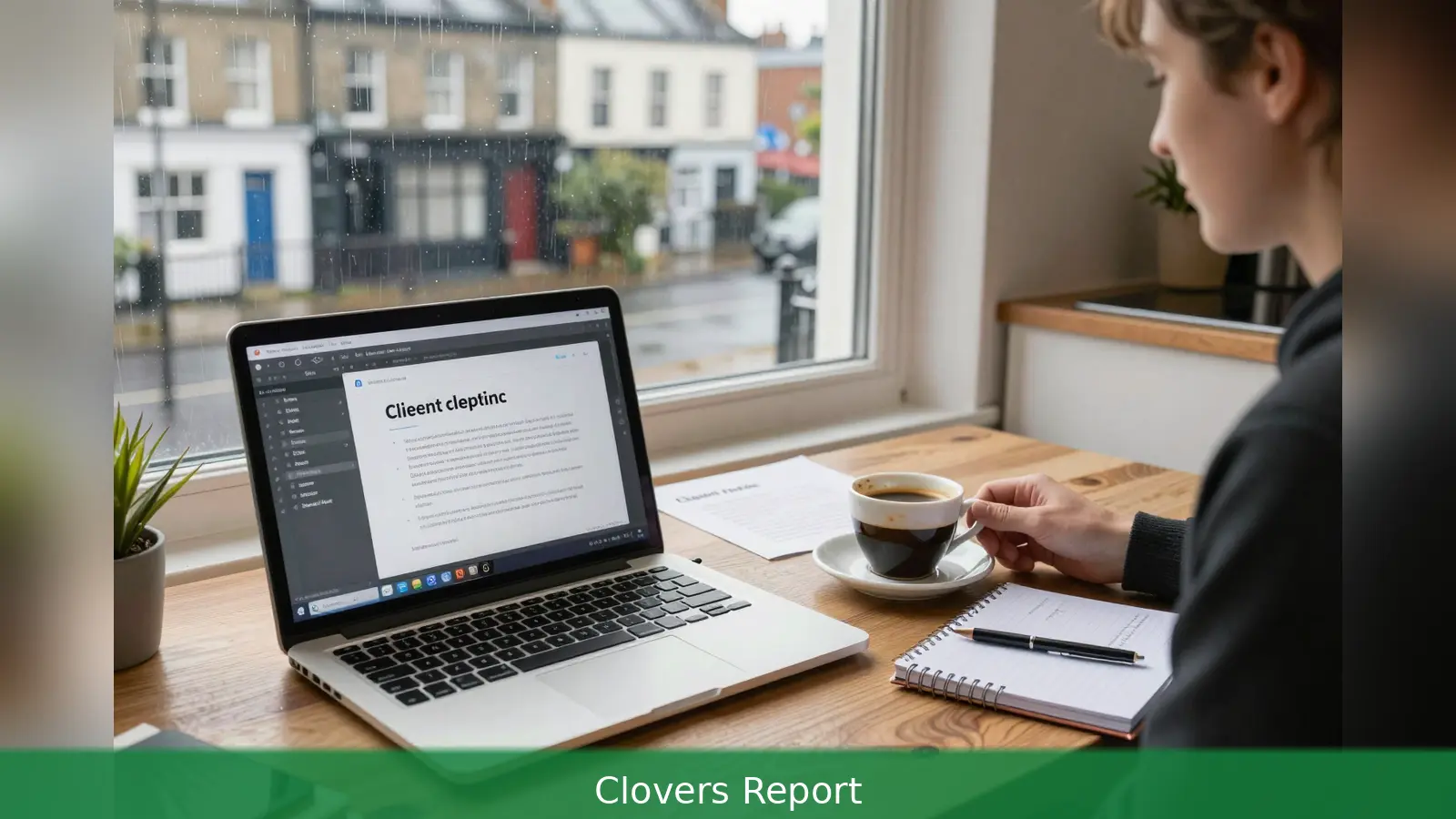
Start small and use a structured 90-day learning and trial plan to turn AI tools into a durable advantage for your freelance business. On a rain-speckled Dublin kitchen table, a freelancer toggles between a client brief, a laptop and an AI drafting app as a late-morning espresso cools. Demand for AI-capable freelancers is rising: Malt reports a 250 percent surge in searches for AI skills since 2022, and the International Monetary Fund estimates AI will affect about 40 percent of jobs globally. But supply is constrained and conversion rates are slipping, with Malt showing matches falling from 25 percent in 2022 to 18 percent in 2023, and an Upwork survey finding more than 60 percent of freelancers say AI increased their output or improved quality.
At a co-working space near Grand Canal Dock, a designer stopped mid-task to rewrite a prompt after an AI-generated mock-up missed the brand tone, then saved the corrected prompt as part of a project template.
1. Assess the market and your skill gaps
First, read the market numbers as a practical instruction, not an abstract threat. Malt reports a 250 percent rise in demand for AI-related skills since 2022 and a fall in conversion from search to match from 25 percent to 18 percent between 2022 and 2023. The International Monetary Fund projects AI will affect about 40 percent of jobs worldwide. Those figures mean two things for freelancers: demand is real and growing, and competition without the right skills will increasingly fail to convert leads into paid work.
Second, run a simple gap audit. List three repeating tasks you perform for clients, then note what part of each task could be sped up by an AI tool and what part would still need human judgement. Keep that list short and practical so it feeds directly into your tool trials and upskilling plan.
2. Choose and trial tools deliberately
Not every platform fits every discipline. Several platforms now embed AI features and change workflow patterns. The sensible approach is controlled experimentation: pick one small, task-specific experiment, run it against a current assignment, and measure three outcomes, time saved, output quality and client reaction.
Many freelancers report positive returns. Upwork survey data shows more than 60 percent of freelancers said AI tools increased their output or helped them deliver higher-quality work. That doesn't mean adopt everything at once. Use trials to judge whether a tool actually improves deliverables in ways your clients value, and save wider changes for a decision point after the trial ends.
3. Integrate AI into workflows with explicit roles and quality controls
The Irish national AI strategy highlights prompt engineering, output evaluation and AI literacy as core practical competencies. Translate those competencies into concrete practice. Treat every AI result as a draft that requires human validation.
Write prompts as spec documents, set measurable acceptance criteria for outputs and build short review steps into project timelines to catch hallucinations or errors before a client sees them.
Document those review steps in the project plan and in client communications. A one-paragraph note attached to deliverables that explains which parts were model-assisted and which were human-verified will reduce surprises and protect reputation. In short, the AI becomes an assistant, not the final author.
4. Protect intellectual property, privacy and ethical standards early
Responsible-use guidance from practitioner playbooks stresses data protection and clear attribution. Before you feed client data into a vendor model, confirm whether the provider stores or trains on inputs. If the work involves sensitive client information, prefer vendors or configurations that offer data isolation, local processing or contractual assurances about training usage.
For creative pieces, be transparent about AI assistance and agree ownership and licensing in writing. Ethical and reputational damage can translate into lost revenue faster than small efficiency gains will return money. Make these checks a part of your project intake so the client and you sign off on the limits and the safeguards up front.

5. Reframe pricing and proposals to reflect combined human plus AI value
As routine portions of work become faster, clients will expect faster turnaround or lower prices for predictable tasks. The reliable way out of the race to the bottom is to price around outcomes and the aspects of your service that remain hard to automate: insight, strategy, judgement, relationship management and final editing.
One practical proposal structure to use with clients breaks work into three components. First, task automation where AI accelerates production, and its measurable scope. Second, human oversight and quality control, including review steps and verification. Third, strategic or creative additions that justify a premium fee. Where you plan to use AI to reduce cost, make the change explicit during negotiation and align a reduced fee with a narrower scope of human work.
6. Develop an upskilling plan tied to specific capabilities
Ireland's strategy for upskilling the digital workforce stresses practical generative AI skills such as prompt design, evaluating model outputs and understanding basic model limitations. Upskilling for freelancers should combine hands-on practice with short vendor courses and portfolio projects that prove you can apply AI responsibly.
Strengthen soft skills as well. Creative framing, client communication and contextual judgement let you turn a model's raw output into a product a client will pay for. Mix short courses with sector-specific portfolio pieces that show a documented workflow, from brief to AI-assisted draft, to human edits and final outcome.
7. Differentiate through portfolio, trust and niche specialisation
Durable differentiation will come from creativity, context awareness and deep niche expertise. Practitioner blogs and guides urge freelancers to build portfolio pieces that show a documented workflow: the problem brief, AI-assisted drafts, human edits, the final outcome and measures of impact. For many buyers, evidence of a reliable process and clear attribution of human oversight is as persuasive as a lower price.
Consider specialising in verticals where domain knowledge amplifies your value. Examples include legal-adjacent editing in Ireland, healthcare communications with privacy-aware workflows, or fintech content tied to EU regulatory change. In each case, a clearly described process that uses AI where it helps and human oversight where it protects trust will win more because it reduces client risk.
8. Adopt a time-boxed experiment and governance routine
Make governance lightweight and repeatable. Freelance playbooks recommend a cadence: trial one new AI tool per month with a defined checklist, document results and then adopt, adapt or abandon after a 90-day review cycle. Keep a compact governance checklist for each client and project that covers data usage agreements, model choice and safety checks, versioning of outputs and a one-paragraph note on how the AI step changed the work.
That one-paragraph note is a cheap trust-builder. It says what model was used, why it was chosen, who reviewed the output and whether the step saved time or introduced risk. Over time those notes form the basis of a portfolio that proves your process and your judgement.
How to run your first 90-day cycle
Several practitioner guides recommend a 90-day start. A common three-month rhythm is: Month 1 is Learn and Explore, Month 2 is Apply and Connect, Month 3 is Innovate and Share. Translate that into practical tasks you can complete while still billing clients.
First month, pick one tool aligned to a core repeating task, complete an introductory course or tutorial, and run a controlled trial on a single client assignment. Measure time saved, track quality differences and collect the client reaction. Second month, expand to a second client or two, refine prompts and templates, and formalise the review steps in your proposals. Third month, package the workflow into a portfolio item, share the results with prospective clients and decide whether to adopt the tool more widely.
Keep the experiments small and the record-keeping simple. That discipline protects you from chasing every shiny new model and gives you a defensible narrative you can show clients: here is the tool, here is the draft, here is the human edit and here is the impact.
Pricing example you can adapt
Do not present a single flat price when AI touches the work. Instead, offer two options. Option A, an AI-accelerated baseline, describes the automated steps, the reduced human hours and a lower fee. Option B, a premium outcome package, keeps AI for task acceleration but layers in strategic input, extra review and guaranteed sign-off, at a higher fee. Make the differences explicit in the scope and let the client choose the risk-reward balance.
Project governance checklist to start with
Use a one-page checklist attached to each brief. It should answer four practical questions, 1) Will the client data be sent to a third-party model, 2) What model or vendor is chosen and why, 3) Which outputs require human sign-off and who provides it, 4) How will final ownership and licensing be documented. Keep the checklist concise so it gets used, not filed.
Those governance habits are simple. They will also protect your reputation, which is the asset you can't rebuild quickly once it's damaged.
In short, the path is deliberate trialing, measured adoption and clear client communication. That sequence turns AI from a threat to a controlled productivity multiplier.
Related Articles
- 10 Steps to Build AI Summarisation APIs That Earn in 2026
- 6-step framework for ML system design
- 4 Best Floodlight Security Cameras 2026: Wired vs Battery
Begin Month 1 by selecting one AI tool that maps to a repeating client task, complete an introductory tutorial on it and run a controlled trial on a single assignment, documenting time saved, output quality and client reaction as your 90-day experiment record.
This article was created with AI assistance.


