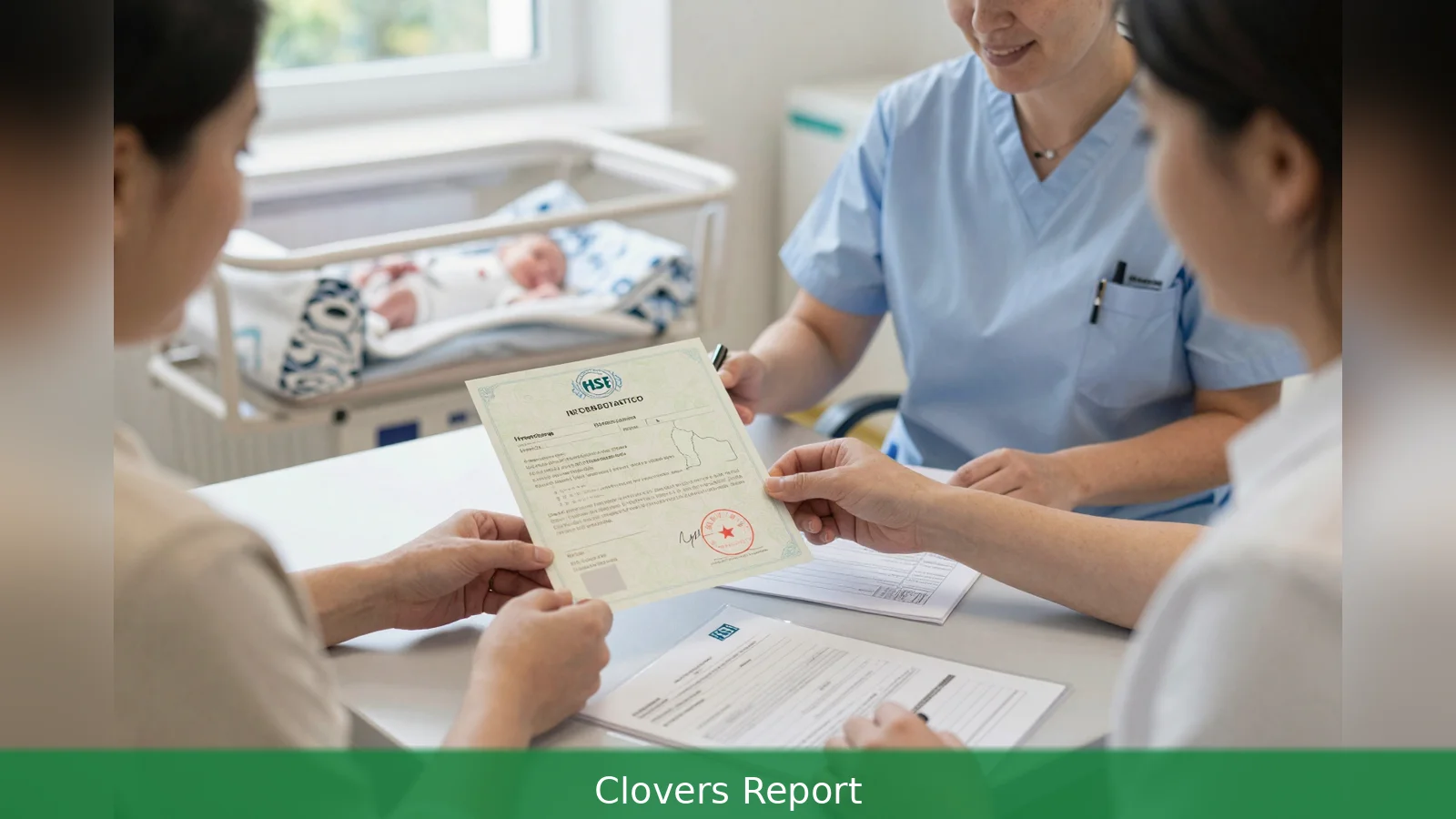
You should expect €140 a month per child, and for babies born or adopted on or after 1 December 2024 a one-off Newborn Baby Grant of €280 is added to the first payment. That cash is paid subject to habitual residence rules, so you must complete the correct claim form and supply identity and residency documents. The moment at the hospital registration desk, when a midwife hands over the birth certificate and a parent signs, starts the administrative process that triggers the claim. Knowing which form to use, what documents to have ready and when payments appear will save time and prevent payment gaps.
Before you leave the maternity ward, check whether the Department will send a claim form for you.
1. Register the birth and let the claim begin
The first practical moment is the civil registration of the birth. If your baby is born in Ireland and you aren't already claiming Child Benefit for other children, the Department of Social Protection will automatically send a claim form when you register the birth, and that notification starts the application process. If you are already receiving Child Benefit, the Department will add the new baby to your existing claim when you register the birth and, in normal cases, payment begins from the month after the birth.
In Department guidance the usual expectation is simple: you will receive your first Child Benefit payment the month after the child is born. In practice that means the payment will appear on the Department's fixed monthly payment schedule, which is capped to a single monthly payment date.
Worked example: a baby born on 12 March, registered promptly, will normally trigger a claim and the first payment will arrive on the Department's payment date for April. Keep the registration receipt and any paperwork you sign at the hospital. They're the trail that shows you complied with the registration step that activates the Department's process.
2. Choose online or paper, and gather identity details
Decide early whether you can claim through the MyWelfare online portal or whether you must use the paper route. The Department describes MyWelfare as the quickest method, but online claiming is available only if you have been invited to apply online by the Department. To use MyWelfare you must have a verified MyGovID account and your own PPSN.
The child will be assigned a PPSN and you must supply your own PPSN when you apply.
If you have received the Department's invitation to apply online, log in to MyWelfare with MyGovID and follow the online claim flow. If you haven't received an invitation, you must complete and return the paper claim form CB1 to the Child Benefit Section. The Department publishes a postal address for the Child Benefit Section in Letterkenny, Co. Donegal, and telephone numbers for enquiries; the claim form and the MyWelfare screens will also prompt for contact details.
Worked example: a parent with a verified MyGovID account who receives an online invite can complete the MyWelfare claim in a single session by supplying their PPSN and bank details. A parent without an invite should expect to fill in CB1 and post it to Letterkenny, allowing time for postal processing.
3. When to use form CB1 and timing to resolve
Keep in mind that not every birth triggers the same route. The paper form CB1 is required when the child was not born in Ireland or when a birth hasn't been registered within the Department's required registration period. The Department's guidance links the need to use CB1 to whether the birth was registered within the required three-month window and doesn't publish a universal 12-month filing deadline on the CB1 page.
That point sits beside other published guidance aimed at applicants which states a 12-month limit for filing an initial Child Benefit claim after a birth or after arriving in Ireland. These two accounts differ on a concrete filing deadline. Treat the Department's explicit registration rule and the CB1 requirement as authoritative. If a birth or arrival falls outside routine timing, contact the Child Benefit Section at the Department of Social Protection to confirm which rule applies to your case.

Worked example: if a child is born abroad and arrives in Ireland, you should expect to complete CB1. If the birth in Ireland was not registered within the Department's required period, CB1 is also the right form. If in doubt about a 12-month limit mentioned in other guidance, phone the Child Benefit Section before assuming the claim is out of time.
4. Extending payments past 16 with form CB2
Payments normally stop when a child turns 16 unless they remain in full-time education, in full-time training, or have a disability preventing them from supporting themselves. To continue Child Benefit beyond a child\u2019s 16th birthday you must complete a CB2 form for each child aged 16, 17 or 18 and supply supporting evidence.
For a child in full-time education the supporting evidence is a stamp from the school, college or training provider. For a child who has a disability and can't support themselves the supporting evidence is certification from a medical practitioner. One guidance source advises submitting a CB2 at least one month before the child's 16th birthday to avoid a payment break. The Department's public pages require CB2 but don't state that precise one-month cutoff, so when timing could affect payments allow enough lead time to obtain the required stamp or certificate and return the form before the child turns 16.
Worked example: a parent whose child turns 16 in September should request and obtain the school's stamp in August and post or upload the completed CB2 so the Department receives it before the birthday, minimising the risk of an interrupted payment.
5. Residency and eligibility checks to expect
The Habitual Residence Condition applies to all applicants, regardless of nationality. The Department requires that the claimant and child be habitually resident in the State for Child Benefit to be payable. Expect detailed questions about residency status in the MyWelfare portal or on paper forms.
Non-EU citizens who are legally working in the State may qualify. Specific cross-border arrangements remain in place for families with connections to the UK. Applicants with non-standard residency should be prepared to provide documentary proof of habitual residence and of immigration or work status when requested by the Department.
Worked example: a parent who has lived and worked in Ireland for several months and holds lawful employment documentation may still be asked to show proof of habitual residence. Keep employment contracts, utility bills or tenancy agreements to hand if the Department requests evidence.
6. Bank details, payment timing and how you receive money
When you apply the Department will ask for bank account details. Child Benefit is paid on the first Tuesday of every month and the Department normally pays the first Child Benefit the month after the birth. The Newborn Baby Grant of \u20ac280 is paid in addition to that first Child Benefit payment for children born or adopted on or after 1 December 2024.
If you don't apply online, the Department's procedures allow payment by post office collection in many cases. The CB1 form and MyWelfare screens will show the payment method selected and will give the Department's instructions for collecting payments by post office. Keep the Department updated if your address, bank, or custody arrangements change because those changes affect where and to whom payments are sent.
Worked example: a parent who provides bank details on the claim will normally receive Child Benefit into their nominated account on the first Tuesday of the month. If the parent opts for post office collection, check the claim form for which post office is listed and bring ID when collecting.
7. Report changes promptly and avoid overpayments
The Department requires that you inform them promptly if circumstances change. The list of changes that must be reported includes a change of address, a child leaving your care, a change of bank or post office, and if you or your child leaves the State. Failing to notify the Department of changes that affect entitlement can lead to adjustments or demands to repay overpaid amounts.
If your child splits time between two households, the Department pays the person with whom the child lives most of the time. If time is split equally, by Department practice the mother receives the payment. Keep records that prove how time is shared if there's any dispute.
Worked example: if a child moves to live permanently with the other parent, inform the Department immediately to prevent ongoing payments to the former claimant and the possibility of an overpayment recovery.
Practical checklist before you apply
First, have your own PPSN to hand. Second, ensure you know whether the Department has invited you to apply online; if so use MyWelfare with a verified MyGovID. Third, if the birth was not registered on time or occurred abroad, be ready to complete CB1 and post it to the Child Benefit Section. Fourth, if your child will be 16 within months and will continue in education or training, get the school stamp or medical certificate for CB2 well before the birthday. Fifth, supply bank details or select post office payment and update the Department if anything changes.
In short: 1. Register the birth and check for the Department's claim form. 2. Use MyWelfare only if invited; otherwise complete CB1. 3. Use CB2 and evidence to continue payments after 16. 4. Provide bank details and expect monthly payments on the first Tuesday. 5. Tell the Department about any change that affects entitlement.
Related Articles
- Child Benefit for a third child: how to apply
- Apply for an Irish passport in 7 steps
- LIBOR rigging: 8 steps that shifted $300 trillion
The Department pays Child Benefit on the first Tuesday of every month. If you qualify for the Newborn Baby Grant, that €280 will be included with the first payment for births or adoptions on or after 1 December 2024.
This article was created with AI assistance.


