
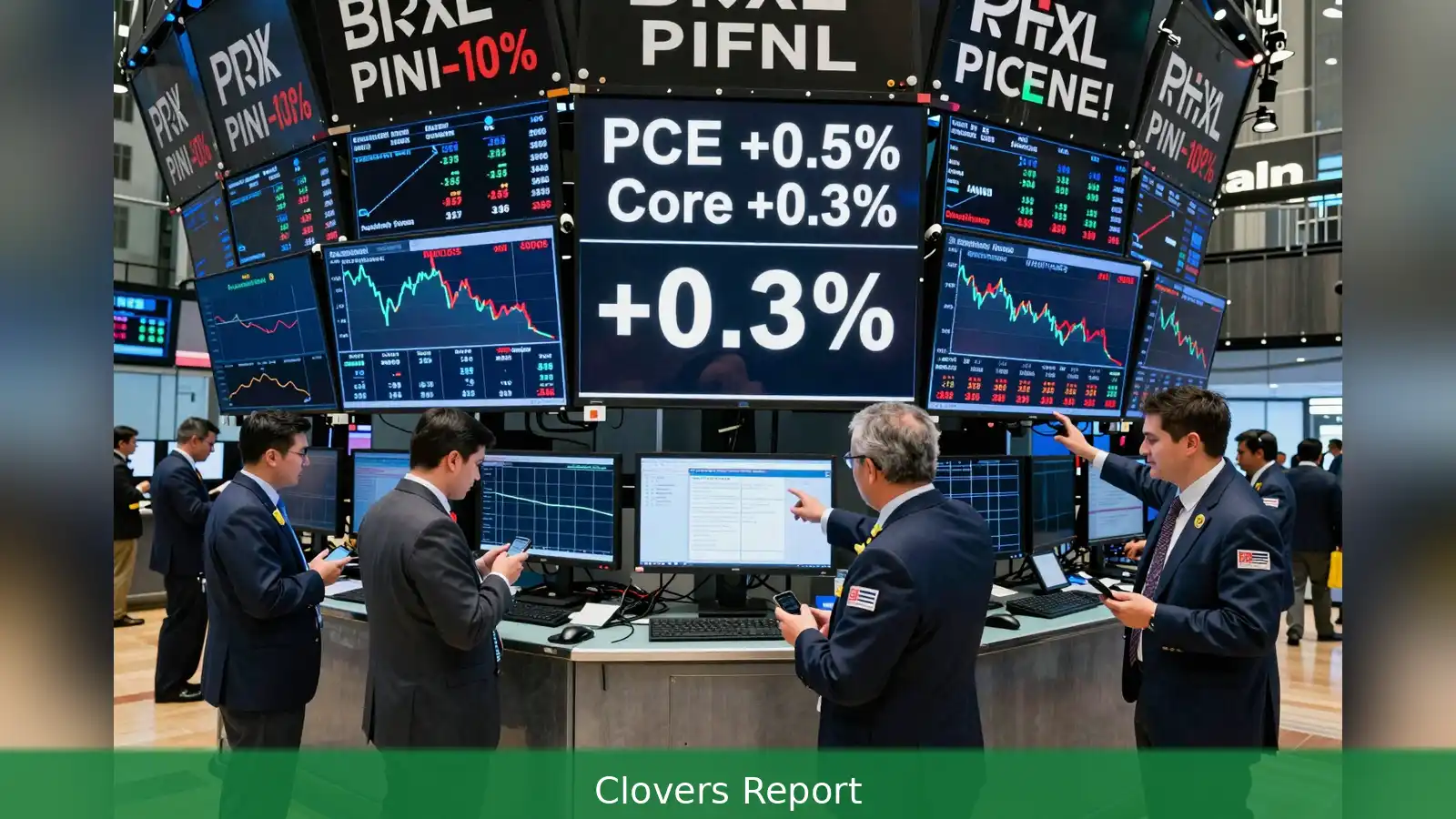
On the New York trading floor at the open, fed-funds futures repriced sharply after forecasts that headline personal consumption expenditures would jump 0.5% in May and core PCE 0.3%, moves that pushed markets to price roughly 1.5 additional Federal Reserve rate hikes by year-end. The analyst consensus tied those monthly increases to year-on-year headline PCE near 4.1% and core PCE around 3.4%, figures that would mark a clear uptick from recent prints. The Bureau of Economic Analysis had already shown April headline PCE at 3.8% year-on-year and core at 3.3%, numbers that left some policymakers uneasy. This May PCE report was due on Thursday morning before the stock market opened, and traders were braced for another volatile open.
On the trading floor the moves landed like a cold splash: futures swung, equity futures slid and rates traders re-ran their assumptions about policy. The immediate market reaction was simple, and stark. A half-percentage-point monthly gain in headline PCE and a 0.3% rise in core would lift year-on-year inflation into territory that forces a fresh policy conversation at the Fed.
Why these PCE components matter
Not all parts of the PCE basket are watched equally. Core PCE excludes food and energy and is the Fed's preferred gauge for underlying inflation, so changes in housing services or financial services can have an oversized influence on the policy signal. Housing services have shown notable monthly gains in recent months, and if those rises prove persistent they will keep underlying inflation elevated rather than letting it roll off.
Financial-services categories looked volatile in April, but producer-price data showed a surge in portfolio-management fees in May. If those higher fees feed through into consumer-facing financial-services costs, they would lift core PCE readings even without a concurrent food or energy shock. The point is technical but material: core PCE is sensitive to sectoral swings that CPI, with different weights, might not capture as quickly.
Those three- and six-month annualised rates matter too. Core PCE has been running at elevated three- and six-month annualised rates in recent months, a pattern that pushes year-on-year core readings higher over time. That persistence is what worries officials who fear a re-acceleration of inflation that would be harder to dislodge.

Policy debate and market repricing
Fed officials have been divided in public comments. Some regional Fed officials warned on May 28 that a failure to see disinflation within the next one to two quarters would be concerning. Fed Governor Lisa Cook said she was prepared to raise rates if the expected disinflation did not appear in a timely manner. At the time of those remarks the Fed was holding its policy rate steady.
Other senior officials have taken a more sanguine view. John Williams of the New York Fed has said policy is broadly in the right place, yet the cohort of policymakers openly warning a hike may be necessary has grown amid recent energy-price volatility and tariff-driven price pressures. That widening internal debate is the policy story behind the market moves: if the Fed's internal read shifts toward persistence, the next step is higher rates.
The bond market has already priced that risk. Yield curves and swap markets are re-pricing the path of policy on the prospect that hotter-than-expected PCE components will force tightening beyond the Fed's present stance. Traders aren't waiting for unanimous Fed language; they're trading on the probability that a few stubborn sectors will keep inflation stickier than officials expect.
Households and businesses would feel any policy pivot in different ways. Consumers confront faster inflation on essentials if energy-driven headline gains bleed into services such as housing and finance.
Businesses could face higher input and financing costs if the Fed reacts, raising the hurdle for investment and squeezing margins. That's the policy trade-off: tamping inflation now can slow demand later.
Market strategists and economists have singled out the two less-visible PCE components that matter most in this setting: housing services and parts of financial services such as portfolio-management fees. Both have the mechanical capacity to lift core inflation readings even without broad-based price pressures, and both are sensitive to trends not fully captured by the headline CPI.
For investors and policy makers the calculus is straightforward. If these sectoral moves prove temporary they will show up as noise in the monthly prints. If they persist they become the story. The May PCE print, arriving before the market opened on Thursday, was the immediate test of which of those two outcomes the data would deliver.
Related Articles
- SEC enforcement actions fall 30 per cent as settlement shield is repealed
- Alphabet joins 30-stock Dow, shifting index toward tech
- 39.1 trillion vs 31.6 trillion: Yass on US debt risk
The immediate test is Thursday's May PCE print. Traders will be watching housing-services and portfolio-management-fee lines for signs of persistence; if those components remain sticky, the market's bet on roughly 1.5 more hikes this year looks increasingly plausible.
This article was created with AI assistance.


