
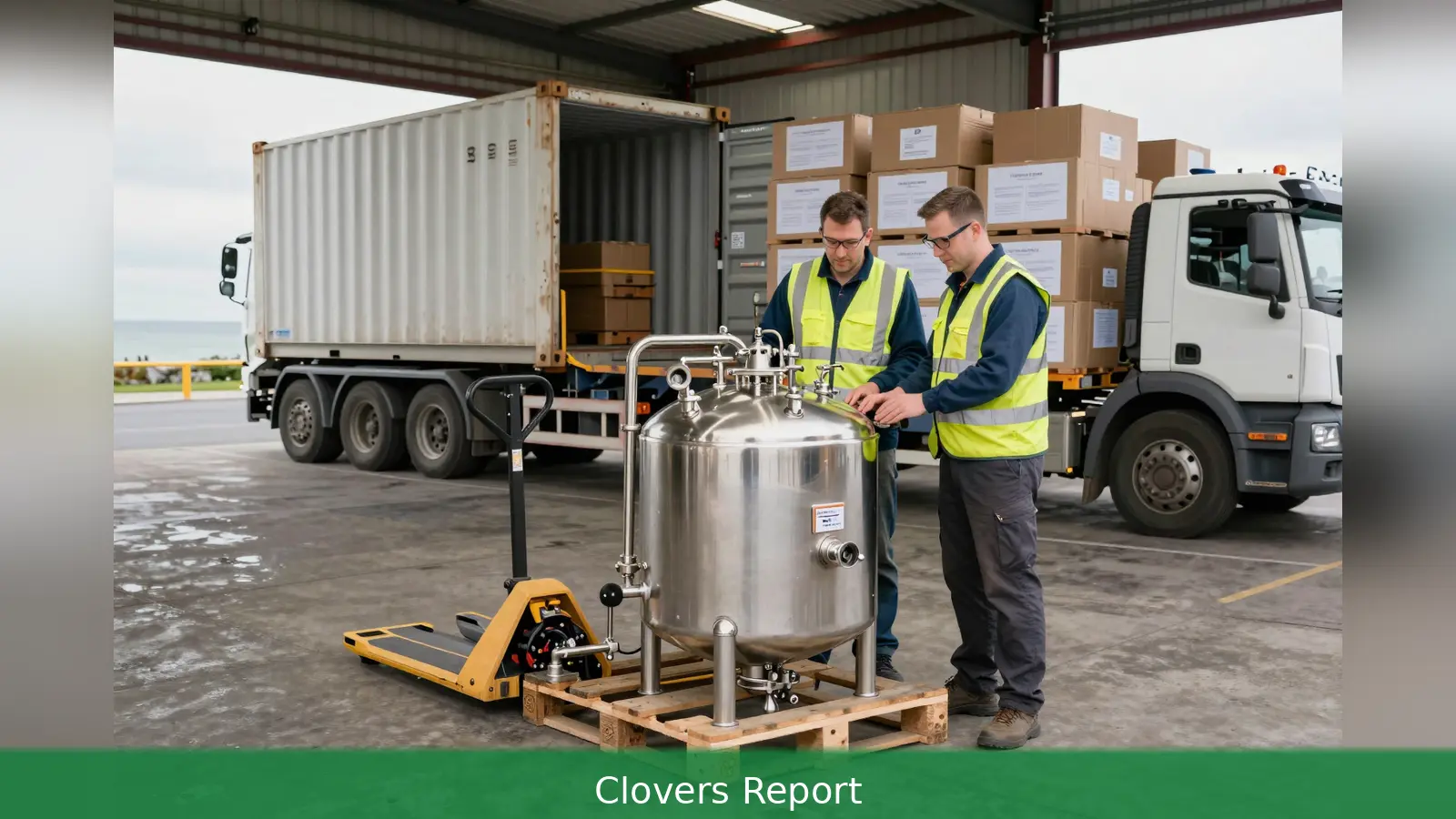
Irish dairy-equipment exporters stand to win stronger sales because the global dairy-processing-equipment market reached USD 12.22 billion in 2025. The market is forecast to expand from USD 12.91 billion in 2026 to USD 21.44 billion by 2034, a compound annual growth rate of 6.50% for 2026 to 2034, according to Fortune Business Insights. Asia Pacific led the market in 2026 with a 40.50% share, a regional surge credited to rising milk production, shifting urban diets and health trends, plus policy and private investment that have encouraged processors to add capacity. That scale matters for Irish makers of pasteurisers, homogenisers, separators, cooling tanks and integrated lines because buyers are choosing suppliers who can deliver food-grade, hygienic equipment and long-term distribution.
That shift is translating into concrete export opportunities for both small Irish firms and established multinationals, with clear technical and commercial demands shaping who wins contracts.
Market numbers and what buyers want
Fortune Business Insights lays out the arithmetic: the sector grew to USD 12.22 billion in 2025 and the consultancy projects a rise to USD 21.44 billion by 2034, driven by a 6.50% CAGR between 2026 and 2034. The consultancy attributes the expansion to several linked forces in Asia Pacific: more milk output, faster urbanisation of diets toward processed dairy, growing health and wellness trends, and both supportive policy and private investment that have encouraged manufacturers and processors to scale up. The region accounted for 40.50% of the market in 2026, a dominant share that is reshaping procurement priorities worldwide.
That buyer shift is technical as well as geographic. Fortune Business Insights itemises the machines in demand: pasteurisers, homogenisers, separators, evaporators and drying machines, membrane filtration systems, churning machines, clean-in-place systems, cooling tanks and mixing equipment. Procurement teams in developed markets continue to favour integrated processing and packaging solutions, while many processors in fast-growing Asia Pacific are focused first on capacity to produce pasteurised and value-added dairy products.
Supplier listings compiled by Mirabake show a wide vendor spectrum. On one end are global engineering groups such as Bühler, GEA, Tetra Pak and Alfa Laval, capable of turnkey, large-scale systems. On the other are specialist system integrators and modular equipment makers who sell niche machines or bespoke lines. That choice matters: some buyers prize single-vendor integration, others prefer modular suppliers who can add capacity piece by piece.

How Irish firms are positioning
Irish manufacturers are already using trade shows and longstanding distributor ties to convert market growth into orders. Firms targeting export markets commonly appear on export-promotion stands and use regional distributors to maintain after-sales support and spare parts supply.
Many exporters design a big share of their machinery for international markets. Long-term distributor relationships and export-oriented product design are common strategies for competing for overseas contracts.
Beyond commercial relationships, the technical specifications buyers insist on are a gatekeeper. Supplier literature and case studies emphasise food-grade materials and hygienic design: stainless steel 316L contact surfaces, hygienic sealing and automation to reduce contamination risk and labour costs. For exporters, meeting these materials and hygiene standards is not optional. It is the difference between a shortlist place and being excluded from tender processes in developed markets, and it is increasingly important for processors elsewhere that want to scale up production without raising food-safety risk.
For Irish manufacturers the opportunity therefore looks twofold. First, there is demand growth to chase: larger processors in Asia Pacific and upgrading buyers in Europe need machinery across the full processing chain. Second, there is a technical premium to capture: firms that can demonstrate food-grade materials, hygienic engineering and integrated solutions stand a better chance of securing higher-value contracts.
That combination of market scale, regional appetite and technical specification explains why Ireland’s exporters are active on the trade-show circuit and why Enterprise Ireland support matters. It also explains why Irish firms vary their offer from modular, export-ready machines to fully integrated processing lines that can sit at the core of a new plant.
Related Articles
- Pulse platform warns banks, helps prevent deposit runs
- Surviving co-owner usually keeps joint bank account funds, bypassing probate
- OpenAI hires policy chief and top researcher before IPO
Watch Enterprise Ireland trade missions and the industry trade-show calendar for the next signs of contract flow, and check the next Fortune Business Insights update for revised market forecasts. Originally reported by fortunebusinessinsights.com.
This article was created with AI assistance.


