
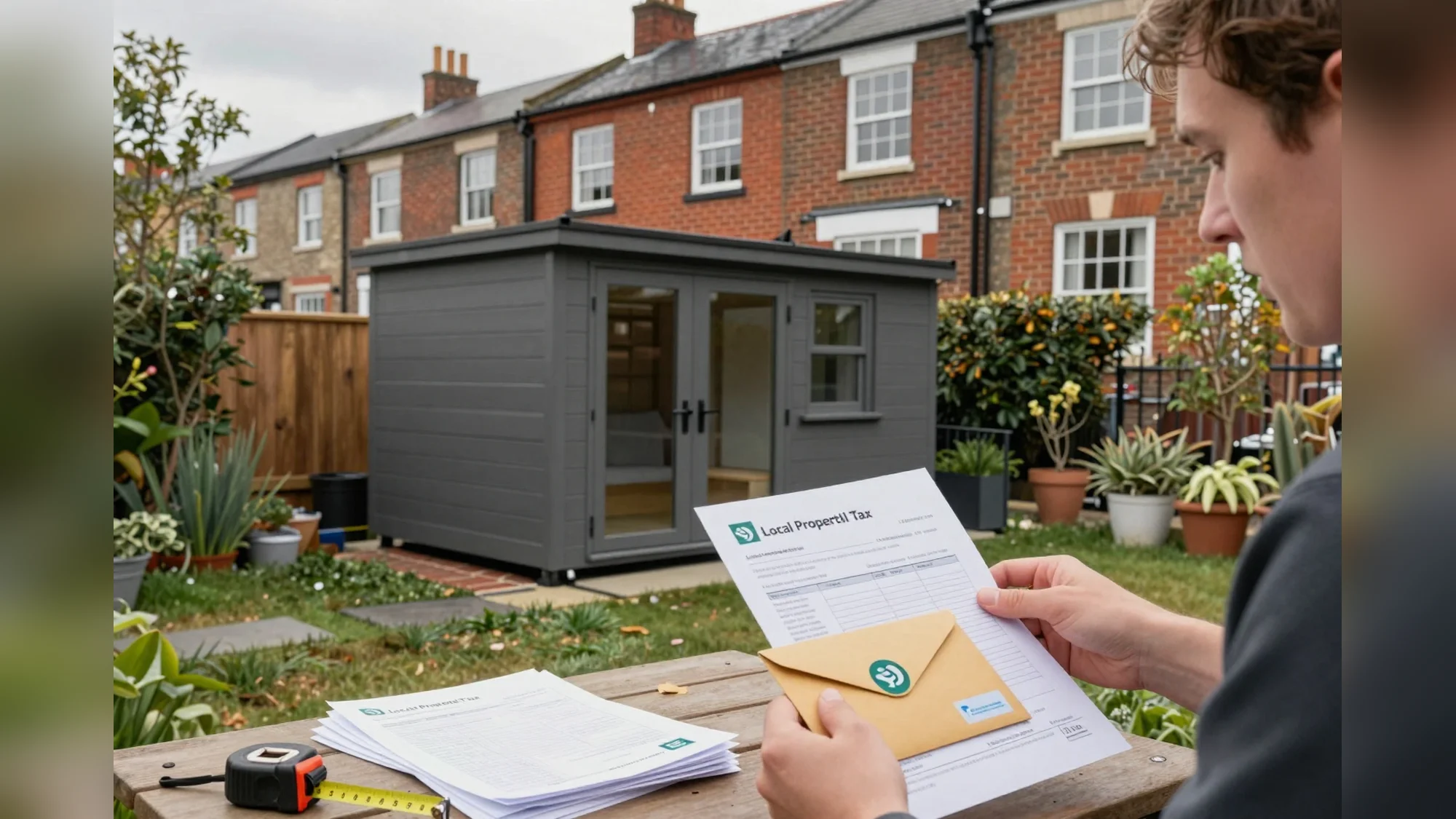
Owners of modular and garden dwellings now face a real risk of being charged Local Property Tax, after Revenue officials flagged unclear guidance in internal correspondence disclosed by RTÉ on July 8, 2026. Revenue found a legal tension between a statutory exclusion for structures that are not permanently attached to the ground and a definition of LPT that applies to "any building which is in use as, or is suitable for use as, a dwelling." The Government has recently moved to exempt small garden homes from planning permission, allowing units up to 45 square metres to be built without approval, a change that has increased prefab and detached garden units in residential plots. Revenue has told the Department of Finance there is no case law to settle the point, and it has recommended that disputed assessments be decided on the individual facts and circumstances of each case.
Owners of modular units could face unexpected tax bills because Revenue says the law is unclear on whether such units count as residential property, and the agency has no single, authoritative interpretation to point to. RTE published Revenue's internal messages on July 8, 2026, showing that officials see a real clash between two parts of the statute: one line excludes structures not permanently attached to the ground, the other captures any building that's in use as, or suitable for use as, a dwelling.
Where the legal tension lies
Revenue documents set out the logic behind the uncertainty. The agency has long treated clearly movable or temporary accommodation as outside the LPT net, examples including mobile homes, shipping containers fitted out as accommodation, houseboats, caravans and camper vans. At the same time, Revenue accepts that a building can be a residential property in its own right whether it's permanently attached or not. Some modular units, the documents note, have a degree of permanence that makes classification unclear, so a tidy bright-line rule isn't available.
The statutory language sits at the heart of the debate. Revenue has emphasised that the legislation makes clear LPT applies to "any building which is in use as, or is suitable for use as, a dwelling," while the law also excludes structures that aren't permanently attached to the ground. That friction is what has sent officials back to first principles and individual case assessment.

The immediate practical consequence falls on property owners who install modular units or convert garden structures for residential use. Revenue told at least one taxpayer that a declared prefab main residence was subject to LPT and that the taxpayer bore the onus of proving otherwise. A Revenue spokesperson also reminded owners that many sites contain garages, greenhouses and other structures that should be included when making a proper assessment of a property's value.
The Government change to planning rules, allowing garden homes of up to 45 square metres to be built without planning approval, has increased the number of prefab and detached garden units in residential plots. That policy step, intended to boost housing supply, has sharpened the tax question.
Revenue officials told colleagues in April 2026 that existing published guidance doesn't refer specifically to modular or garden dwellings and that there's no relevant case law to resolve the point.
Revenue has already been engaging with the Department of Finance. In an April communication, officials recommended that contested assessments be decided by reference to the individual facts and circumstances of each case rather than by a single bright-line rule. There's no scheduled court case or statutory amendment recorded in the material. Revenue has signalled that resolution will come either through clarified guidance or through case-specific determinations.
For owners planning to add a garden room or a modular unit, the practical advice from Revenue's correspondence is stark. Where permanence or suitability for residential use is disputed, the tax status will hinge on the particular facts, and the burden of proof sits with the owner who wishes to avoid LPT.
Related Articles
- 38% exit tax: accumulating ETFs usually win for Irish investors
- Capital gains tax: 33 per cent and what you pay
- 7 steps to apply for Revenue income tax jobs 2026
Revenue told the Department of Finance in April 2026 that, given the lack of case law and confusing guidance, disputed LPT assessments should be decided on the individual facts of each case; until guidance is clarified or a legal test is established, that remains the administration's position. Originally reported by RTÉ.
This article was created with AI assistance.


