
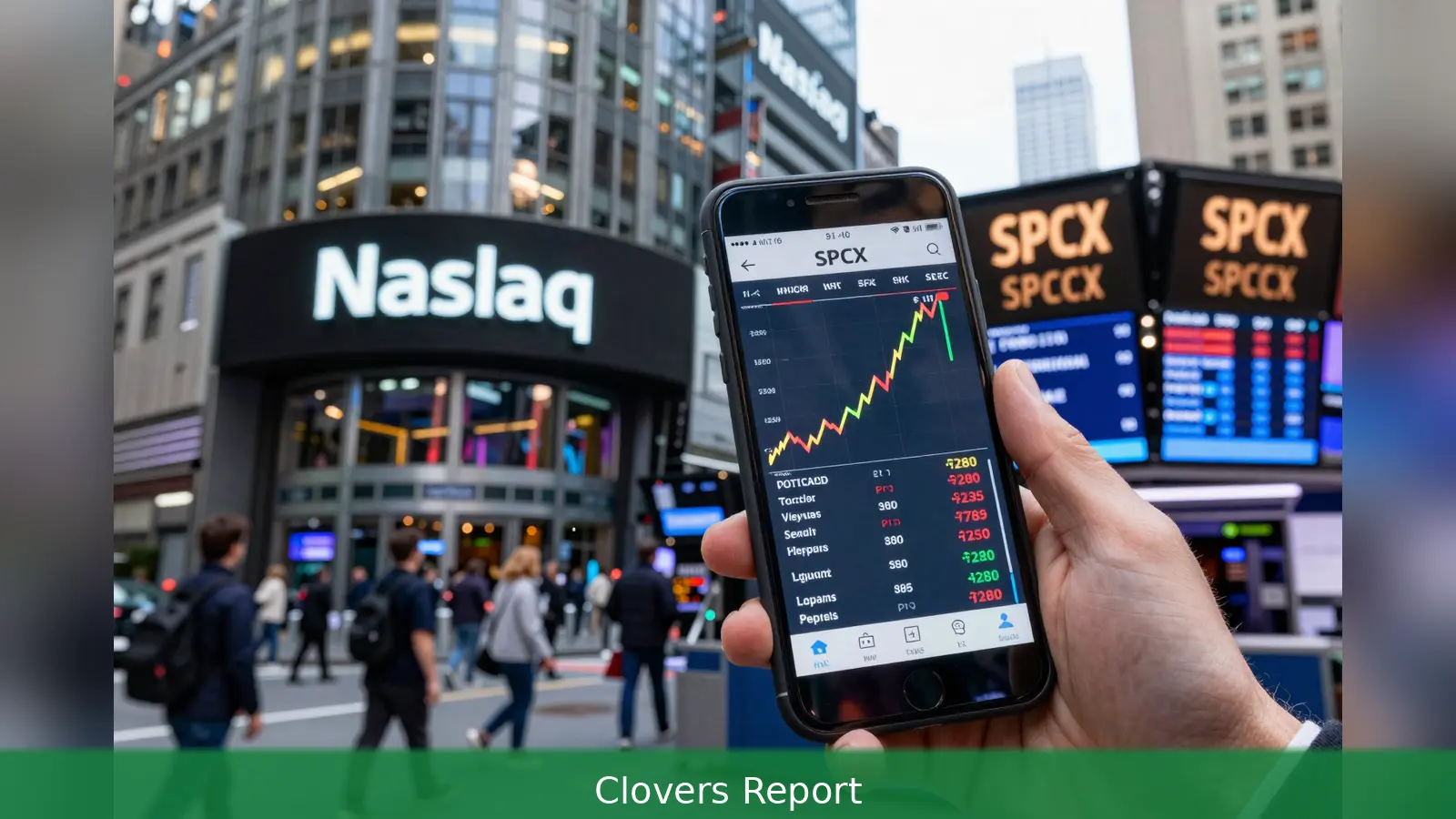
SpaceX sold $75 billion of stock but the market placed the company at about $1.75 trillion when trading began. The company priced 555.6 million shares at $135 each in an offering that began public trading on Nasdaq under the ticker SPCX on June 12, 2026. Shares opened at $150, climbed through the session and closed the first day above the offer price, generating record volume on trading platforms and heavy media attention. The listing converts SpaceX from a tightly held private group into one of the largest public corporations, while keeping Elon Musk's voting control highly concentrated.
Wall Street earned roughly $500 million in fees while retail platforms dealt with record-breaking traffic, a contrast that sums up the scale and appetite for the deal.
Deal mechanics and the numbers
SpaceX filed a public S-1 on May 20, 2026, and priced the offering at $135 per share for about 555.6 million shares, targeting proceeds of roughly $75 billion. That figure is the cash the company raised directly from investors, but the price implied a pro forma market capitalisation in a narrow range around $1.75 trillion to $1.78 trillion depending on timing and calculation method. The shares began trading on Nasdaq under the ticker SPCX on June 12, 2026.
The underwriting package included a standard green shoe option allowing underwriters to sell up to 15 percent more shares if demand remained strong. Reporting attributed approximately $500 million in total underwriting fees to the transaction and named Goldman Sachs and Morgan Stanley among the lead arrangers.
The company allocated shares for retail participation, a detail that helped amplify public interest and platform traffic on debut day. Robinhood said it saw record-breaking traffic on its platform in the hours after the markets opened, and trading platforms broadly reported exceptionally heavy volumes as the stock went public.

Market reaction and strategic shape
The market move was immediate and volatile. Shares opened at $150, an 11 percent premium to the IPO price, and intraday trading pushed prices as high as 30 percent above the offer. On its first full trading day after the debut, prices continued to climb, with an intraday quote near $186.15 as of 2:30 p.m. ET on June 15, 2026.
Heavy volume and rapid price appreciation tested exchange systems and third-party brokerages while generating intense media coverage.
The offering reshapes who owns SpaceX and how the company will be valued publicly. Forbes reported that Elon Musk controlled roughly 42 percent of SpaceX equity and about 85 percent of its voting power prior to the IPO. The public float created by the sale increases free-market access to SpaceX's business lines, spanning launch services, the Starlink satellite broadband network, and the recently consolidated xAI business, while leaving Musk with concentrated voting influence. That split between economic ownership and voting control is a structural feature investors will weigh alongside growth forecasts.
Commentary since the listing has focused less on the spectacle and more on scale. Forbes published headline metrics including a FY2025 revenue figure of about $18.67 billion for SpaceX, and analysts and commentators have pointed out that the company is no longer solely a launch business but a multi-revenue enterprise combining launch, satellite broadband and artificial intelligence. Inclusion in major indices and the related passive flows was widely noted as a point of attention for asset managers and market watchers evaluating demand and liquidity over coming months.
For banks, the fee pool was sizeable. Lead arrangers and co-managers walked away with a large fee, the roughly $500 million figure reported in coverage. For retail platforms, and for investors who wanted a piece of what had been a private company, the listing opened access to a business that had grown well beyond rockets.
Operationally, the debut was a concrete milestone: a S-1 filing, a priced deal and the first trades on Nasdaq. The market has already re-priced SpaceX several times in the days after listing, and the initial volatility underlines how quickly sentiment can shift when a mega-cap private company enters the public arena.
Related Articles
- S&P 500 blocks SpaceX early entry, rules left intact
- Five join Nasdaq 100 as SpaceX IPO looms
- Orbio raises $21m to speed frontline hiring
The offering comprised 555.6 million shares priced at $135 each, raising about $75 billion. Investors will now watch index inclusion, how secondary-market liquidity evolves and SpaceX's next regulatory filings for cues on voting-class structure and disclosure.
This article was created with AI assistance.


