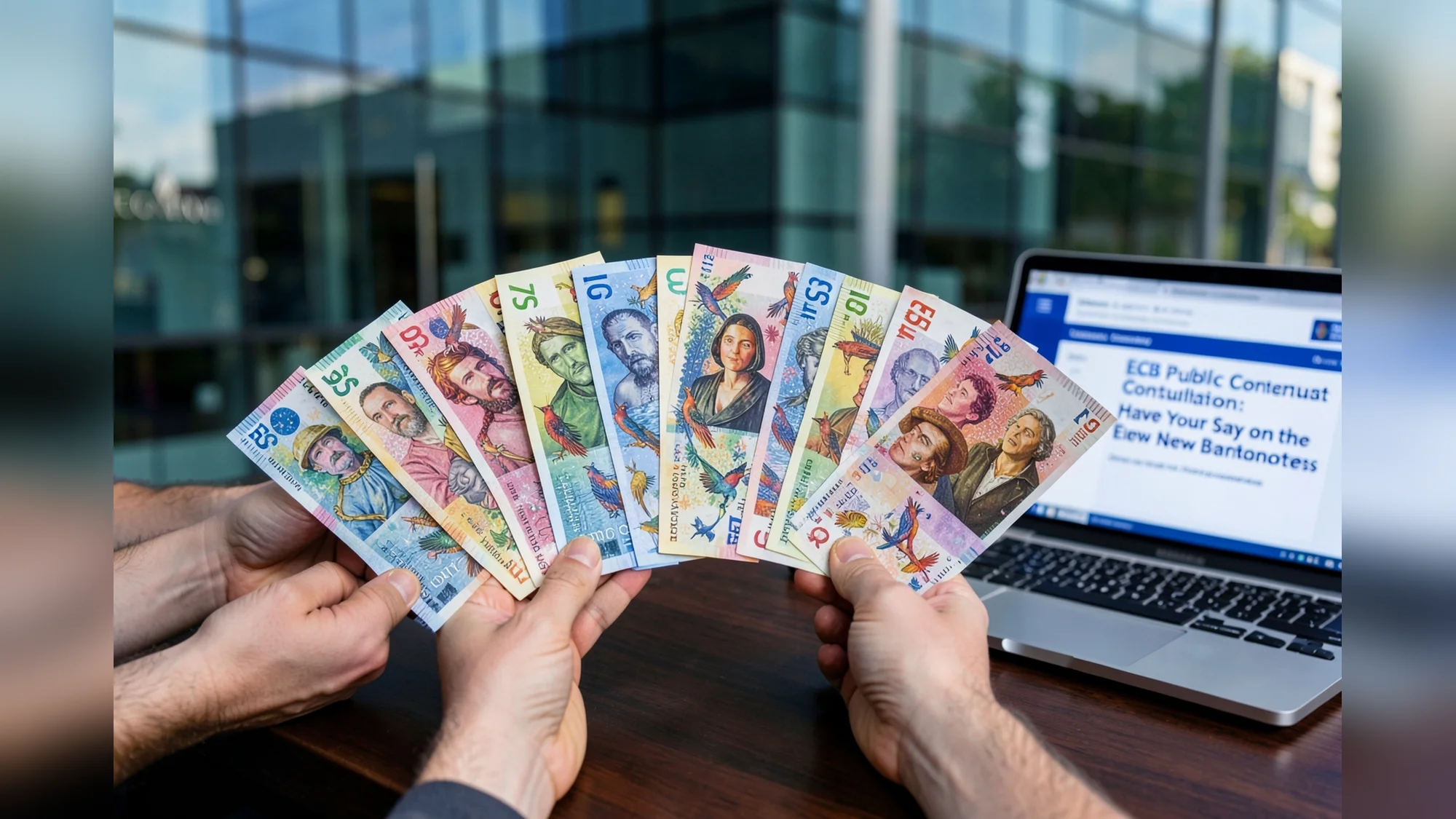
"Euro banknotes are more than a means of payment, they're one of the most tangible expressions of Europe," Christine Lagarde said on 23 July 2026. The European Central Bank unveiled ten shortlisted design proposals chosen from more than 1,200 submissions and opened an online public survey that runs until 21 September 2026. The concepts fall into two themes, labelled European culture and Rivers and birds, and the ECB said the redesign will include improved security features while retaining continuity with existing notes. This Governing Council will weigh jury findings, technical advice and the survey before selecting a final design around the end of 2026.
"Through designs that combine beauty and meaning, they will reinforce our shared identity," Christine Lagarde added, framing the change as cultural as well as technical. The shortlist is the outcome of an EU-wide design contest run by the Eurosystem that attracted over 1,200 applications from graphic designers. Twenty-five designers were then invited to develop proposals under two themes, and an independent jury of 21 experts, each nominated by a euro area central bank, selected the ten finalists.
One theme, labelled European culture, places historic figures on denominations. The proposals show Maria Callas on the \u20ac5, Ludwig van Beethoven on the \u20ac10, Marie Curie on the \u20ac20, Miguel de Cervantes on the \u20ac50, Leonardo da Vinci on the \u20ac100 and Bertha von Suttner on the \u20ac200. The competing nature theme pairs European river landscapes with bird species and places an EU institution on the reverse of each denomination.
The ECB described the redesign as the first full update of euro banknotes since their introduction in 2002. Officials said the new series will include improved security features and will be developed and tested before production.

At the same time the bank emphasised continuity: existing euro banknotes will keep their value and continue to circulate alongside the new series once it's introduced, the statement said.
The bank presented the exercise as part of a long-term effort to ensure cash remains a secure and accessible means of payment. The ECB said the redesign aims to preserve citizens' access to central bank money and their freedom to choose how to pay. That line makes the change explicitly policy as well as aesthetic.
Practically speaking, households and businesses that use cash, banks, cash-handling firms and public institutions are the primary constituencies for the change, the ECB said. Retailers and cash-in-transit operators will need to adapt machines and procedures to new security features once the series is finalised and produced. Those practical adaptations are part of the technical assessment that will feed into any final decision.
The Eurosystem has opened an online public survey on the ten proposals and said it will remain open until 21 September 2026. The ECB will run that open poll in parallel with a representative survey conducted by an independent research company, signalling that the public consultation is an explicit element of the Governing Council\u2019s decision process. Gabriel Makhlouf, Governor of the Central Bank of Ireland and a member of the ECB Governing Council, urged people in Ireland to take part and share their views on the proposals.
According to the ECB\u2019s 23 July 2026 press release, the Governing Council will combine the Design Contest Jury conclusions, a technical assessment and the survey results to reach a final decision. Once the Governing Council selects a design, the chosen concept will undergo further development and testing before production. The bank didn't give a firm circulation date, saying only that banknotes from the new series are expected to enter circulation in subsequent years.
Related Articles
- Inflation 3.4% in June, energy pain persists
- ECB warns 25x hedge fund leverage could hit euro bonds
- Europe's stocks lack tech: just 8% versus 42% in US
The public consultation closes on 21 September 2026, and the Governing Council will probably pick a design by the end of 2026. Originally reported by ecb.europa.eu.
This article was created with AI assistance.


