
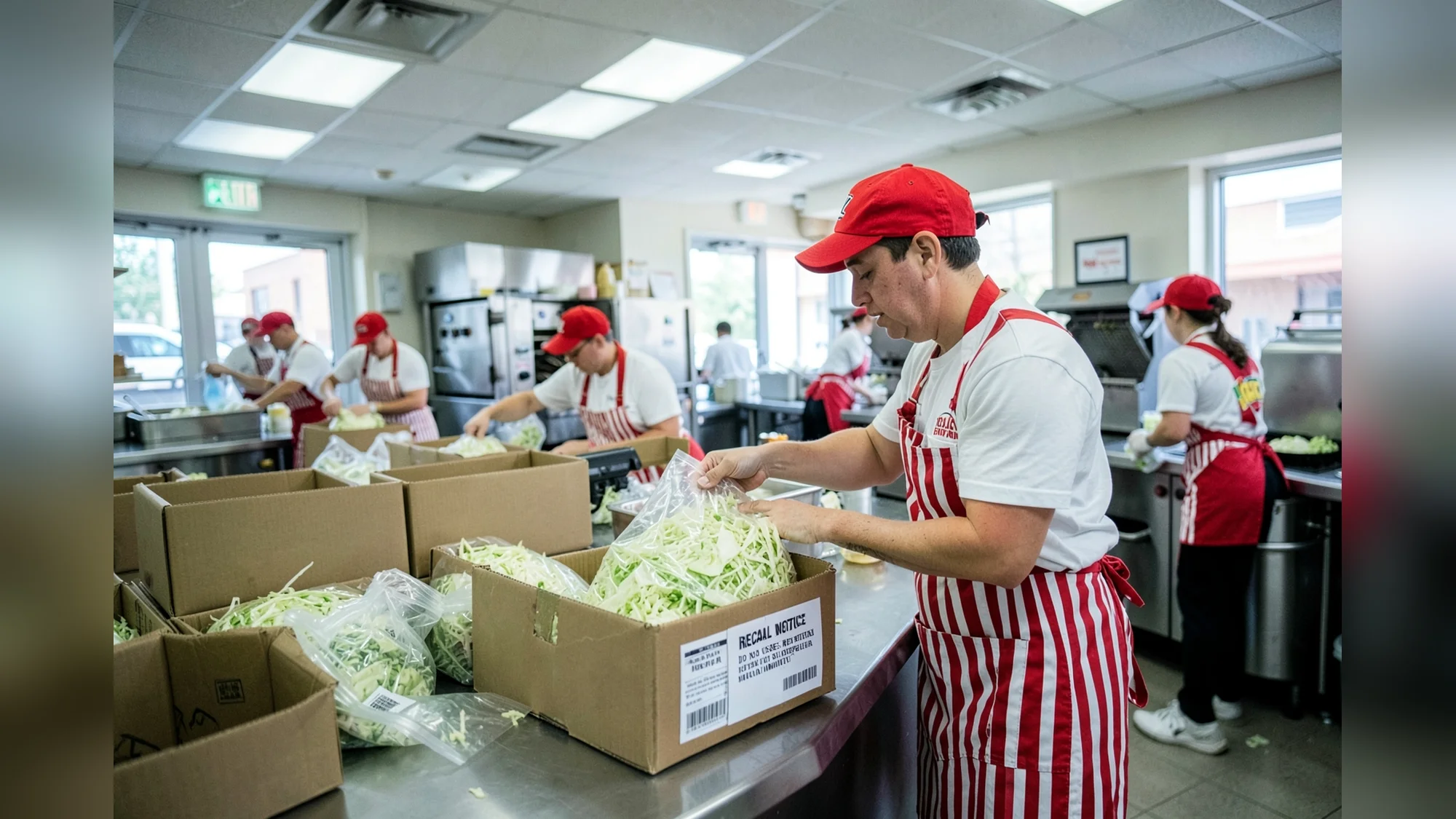
Shredded iceberg lettuce distributed through Taylor Farms' foodservice business reached Taco Bell restaurants and other foodservice customers across multiple states, CNBC reported, showing how a single supplier error can ripple through national food chains. The Centers for Disease Control and Prevention reported 4,173 laboratory-confirmed domestic cases of cyclosporiasis and said it was aware of more than 7,400 additional suspected cases, counts that cover the 2026 season through July 20, 2026. Taylor Farms de Mexico issued a voluntary recall on July 17, 2026 for shredded iceberg lettuce sourced from central Mexico, a recall that included some product sold under the Marketside brand at Walmart and reached consumers, restaurants and retailers in at least 27 states. Federal and state health agencies continue tracing and testing while the CDC will publish weekly cyclosporiasis surveillance updates through the 2026 season.
Restaurants and retailers scrambled after recall notices landed, discarding product and removing items from service lines as investigators tried to pin down a common source. Federal and state health agencies have linked a multistate cluster of Cyclospora infections to shredded iceberg lettuce that moved through national foodservice distribution channels, and the Food and Drug Administration and the Centers for Disease Control and Prevention have been working with state health departments to trace distribution and identify shared exposures.
How a centralised supply chain spreads risk
Food safety experts say the structure of the modern produce industry has likely magnified what might once have been a local problem. David Relman, professor of microbiology and immunology at Stanford University, said the food industry’s sourcing and distribution trends "have played some role here." Marion Nestle, professor emerita of nutrition, food studies and public health at New York University, said "Consolidation means that if something goes wrong, it goes wrong big time."
Both experts pointed to familiar mechanisms. Chopped or bagged lettuce commonly mixes leaves from many heads and from multiple growing sites. Large suppliers then ship that pooled product into broad national networks. The result is that a contaminated batch can reach restaurants and grocery shelves across many states rather than staying a localised event.
Investigators have warned clinicians that routine stool tests may not detect Cyclospora and that specific testing is often required. Symptoms usually begin about one week after exposure and can include watery diarrhoea, fatigue, loss of appetite and cramping.

Without appropriate treatment, symptoms can last for weeks.
Corporate response and regulatory friction
Taylor Farms de Mexico has been a focal point of the tracing because FDA work pointed to shredded iceberg lettuce sold into foodservice. The company issued the voluntary recall on July 17, 2026, said it would stop sourcing iceberg lettuce from growers in central Mexico for the remainder of the season, and deployed company specialists to probe possible origins.
The company’s founder and CEO, Bruce Taylor, also sought high-level engagement as the investigation unfolded, including dispatching a lobbyist to request meetings with officials. News reporting noted disagreements between the company and federal agencies over test results.
The FDA at one point said a sample produced a false positive and later reiterated that epidemiological data strongly linked the outbreak to product traced to the company’s supply chain.
The practical fallout has been immediate. Restaurants and retailers received recall notices and were instructed to discard or return implicated product. Public health guidance has urged consumers to avoid recalled lettuce, to thoroughly wash surfaces that contacted the product, and to seek medical testing if symptomatic.
The CDC adjusted its surveillance procedures for the season because case counts were higher in multiple states than during the same period in 2025. The agency moved to publish weekly cyclosporiasis surveillance updates for 2026 as investigators refine the confirmed case count and seek to tie specific outbreaks to traced products.
Federal and state tracing and laboratory work will continue, with the CDC publishing weekly surveillance updates through the 2026 season as investigators attempt to refine confirmed counts and the scope of outbreaks tied to specific products. Originally reported by CNBC.
This article was created with AI assistance.


