
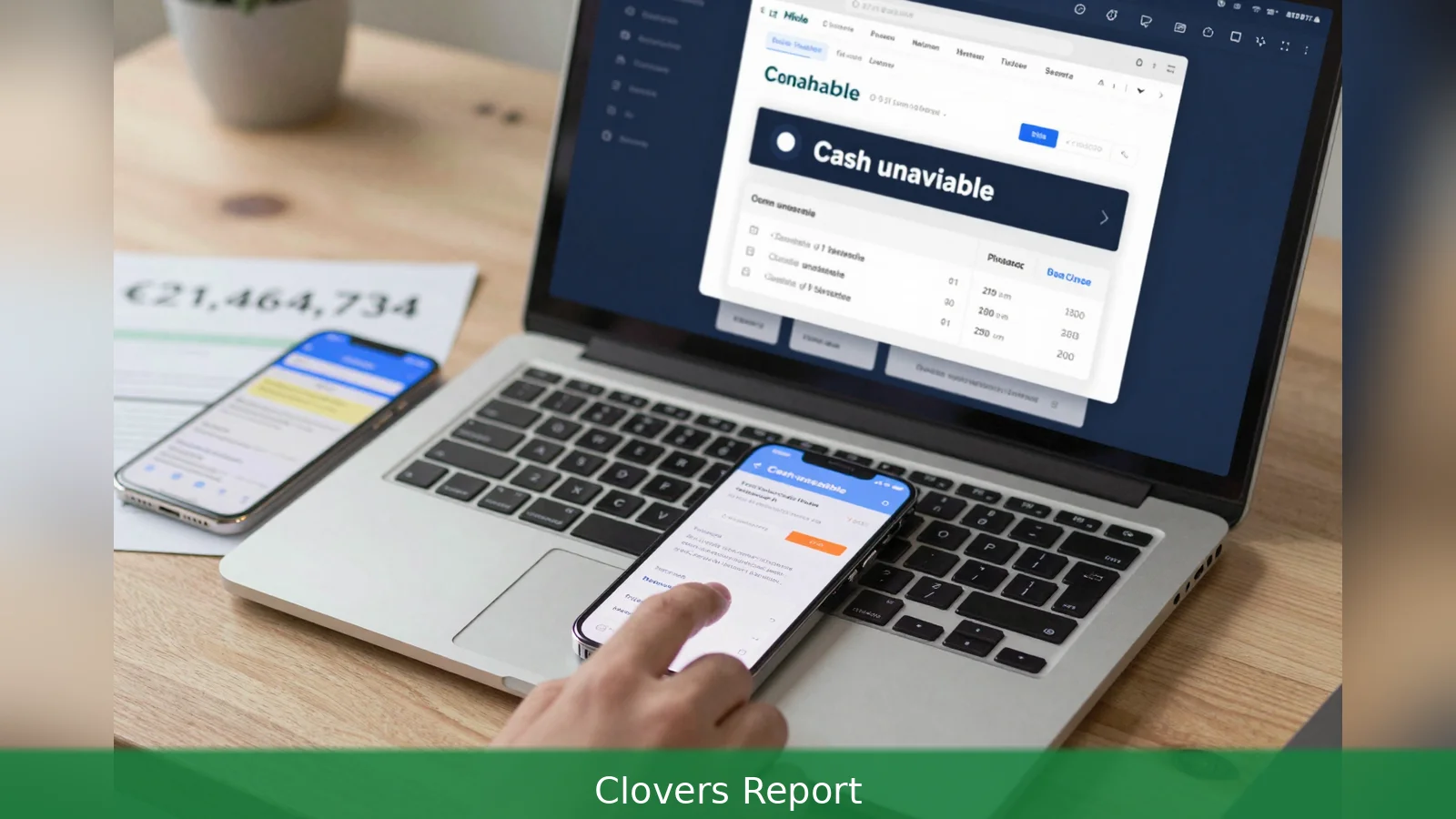
You click Buy and the order fills, but the cash line on the screen reads unavailable. That freeze isn't a bug, it's how Coinbase separates an account's settled cash from provisional credit and noncash assets, and it matters if you trade actively. Ireland's Central Bank fined Coinbase's European arm €21,464,734 in November 2025 after finding gaps in transaction monitoring, a reminder that back-end controls and holds sit inside a wider compliance system that shapes how quickly platforms release funds. For active traders the practical takeaway is simple: check the balance screens, match the balance type to the market you plan to use, and favour debit card deposits if you need near-instant on-platform trading.
On the Coinbase order screen the trade registers but the cash balance reads unavailable, and your next planned move stalls. That exact moment frames the rest of this guide: platform holds are the operational rule that governs whether you can send money off the exchange, move it into other markets, or immediately redeploy sale proceeds. I will walk through the hold mechanics, what you can still do while money is held, how to check availability, practical workarounds, and why a major regulatory enforcement matter in Ireland matters to traders everywhere.
1. Which balance governs the trade you plan
The first rule for any active trader is to identify which balance the market you intend to use will accept. Coinbase separates an account's value into cash, noncash assets and provisional credits. In its help documentation Coinbase defines Available balance as the portion of an account that can be transferred or cashed out, calculated as total account value minus noncash assets such as crypto, stocks and funds. That sounds technical, and it is. But the trading effect is straightforward: different markets read different balance types.
First, for simple spot crypto trading inside Coinbase, crypto you buy with cash that's on hold can usually still be sold or used to buy other listed crypto on the platform. Scenario: you buy Bitcoin with a deposit that triggers a hold; you can still sell that Bitcoin for Ether within Coinbase, but you can't send the Bitcoin to a hardware wallet or to another exchange until the hold lifts. Second, securities-like products such as stocks and ETFs require Settled cash. Proceeds from a stock sale become available to buy other securities only after the standard settlement period completes. Third, derivatives and some offshoot markets look at a different pool: the platform directs users to their USD or USDC balance pages to view derivatives-eligible funds. Fourth, DEX trading may present its own availability within the DEX trade flow that differs from the general available-balance summary. The practical point is this: match the instrument to the balance the instrument accepts before you place a dependent trade.
2. What triggers a hold and how long it lasts
Holds arise for predictable operational reasons. Coinbase places holds on cash deposits, recent purchases, sale proceeds that haven't yet settled, and sometimes because of account history, payment method or unusual transaction patterns. The platform's guidance says duration varies with account history and payment activity. Users receive a confirmation email stating the date when assets will be available to transfer, and a second email when the assets clear.
Timing matters. Coinbase states that holds typically expire on the date listed, though holds may be extended for disputed transactions or security reasons. Importantly, the company says Customer Support cannot shorten a hold. Wire transfers and debit card purchases don't automatically remove existing holds; they don't change availability to cash out when a prior hold is in place. That last point undercuts a common hope among active traders who expect customer service to speed a clearance in a pinch.
3. How holds translate into trading limits and order planning
If you execute many intraday moves, holds will shape your strategy. Cash on hold restricts sending and certain market types even while you retain the ability to trade inside Coinbase's spot environment.
Selling crypto you bought with held cash will increase the crypto position in your account and can free buying power for other on-platform crypto purchases, but this action won't permit immediate transfer of value off the platform.

Think through timing dependencies. If your strategy depends on moving funds between exchanges, arbitraging between decentralized exchanges and centralised venues, staking immediately after purchase, or sending newly bought crypto to a counterparty, holds can break the timing assumptions those strategies rely on. For securities, remember the settlement clock: sale proceeds only increase available cash for further securities purchases after the platform's standard settlement period has passed.
4. How to check availability before you place dependent trades
Always confirm availability inside the trade flow. Coinbase says users can view balance availability by starting a transaction and selecting the Available tooltip, or via the account home Cash screen where the user picks the currency and selects See Balance Summary. The balance summary shows the amount that can currently be traded or transferred. For derivatives or DEX operations, navigate to the USD, USDC or DEX-specific pages to see the funds that are actually available for those markets.
Practical scenario: you plan to buy a leveraged derivative that requires USD collateral. Before you hit Buy, open the USD or USDC balance page and the trade flow to confirm that the collateral is listed as eligible. If the trade interface shows a smaller available balance than your account summary suggests, the trade will fail or be rejected when routed. Coinbase also emails the two standard notices: the initial confirmation with an availability date, and a second email when the hold lifts. Those emails are the platform's way of time-stamping availability, so keep them for your trade diary.
5. Workarounds that fit the rules
There are practical steps you can take where the rules allow. Coinbase points to debit card deposits as the simplest route to near-instant trading eligibility for on-platform crypto. Depositing with a debit card allows immediate trade for many on-platform crypto purchases. If you expect to need the ability to send or withdraw immediately, don't rely on cash deposits that may be placed on hold; instead plan fund clearings ahead of time.
For securities, plan around settlement windows. If you sell a stock and want to redeploy the proceeds into another ETF, count the standard settlement delay into your trade plan rather than assuming instant reuse. And crucially, because Coinbase states support cannot shorten a hold, don't treat customer service as an emergency release valve for a hold that blocks an important trade.
6. Why the regulatory context matters to traders
Holds and availability don't exist in a vacuum. In November 2025 Ireland's Central Bank imposed a financial penalty on Coinbase's European entity for failures in transaction monitoring. The regulator found that faults in the exchange's transaction-monitoring system left more than 30 million transactions unmonitored during a 12-month window, amounting to transactions worth in excess of €176 billion. The Central Bank concluded the firm had not maintained adequate internal controls and had taken almost three years to complete monitoring of the affected transactions. This settlement reduced the original assessment; the final fine recorded in regulator material and comprehensive reporting is €21,464,734, while some news reports round that figure to €21.5 million.
That enforcement action isn't a direct rule about account holds, but it makes two linked points clear. First, back-end controls that determine holds are part of the same compliance architecture that monitors deposits, transfers and suspicious activity. Second, regulators are scrutinising these systems, which can lead to audits, operational changes and tighter controls that may affect how holds are applied or how quickly funds are released in future remedial programmes. Active traders should therefore watch both immediate availability rules and the broader regulatory environment that shapes platform operations.
How to build an availability checklist into your trading routine
Turn the hold mechanics into a short habit. Before any trade that depends on immediate transferability, do the following in sequence. First, open the trade flow and tap the Available tooltip to see the balance the market will accept. Second, check the account Cash screen, select your currency and choose See Balance Summary to confirm what's transferable or cashable. Third, if you need to move value off the platform after buying, avoid cash deposits that might be held and use a debit card deposit when immediate on-platform trading is enough. Fourth, for securities, plan around standard settlement periods; don't assume sale proceeds are available to buy other securities until settlement completes.
Worked example: you plan an arbitrage between a DEX and Coinbase. If you fund Coinbase with a bank transfer that's likely to be placed on hold, you won't be able to send the purchased token off-platform even if Coinbase lets you trade the token within its spot market. The arbitrage window will close. To preserve timing, deposit by debit card for immediate spot trading, and move cleared funds well before you attempt cross-venue transfers.
Risk management takeaways
Active traders must fold holds into their risk model. A single unexpected hold can prevent a planned hedge, leave you exposed to market moves, or lock value on-platform when you intended to rebalance elsewhere. That's operational risk, and it compounds with compliance risk when regulators step in and demand system fixes. Keep a margin of timing in your plans and treat the platform's emails as binding time stamps for when assets will be transferable.
In Short
1. Check the Available tooltip in the trade flow and the Cash screen See Balance Summary before placing dependent trades. 2. Crypto bought with cash on hold can usually be traded inside Coinbase but can't be sent off-platform or used in some markets until the hold lifts. 3. Securities and ETFs require settled cash for new purchases; sale proceeds are only usable after settlement. 4. Debit card deposits are the fastest route to immediate on-platform crypto trades; Customer Support cannot shorten existing holds. 5. Regulatory enforcement in Ireland in November 2025, including a €21,464,734 fine, shows how compliance controls and holds sit inside the same operational architecture that affects availability.
Related Articles
- AI for jobseekers: 7 rules to avoid being flagged
- Data lineage: 7-step guide to pick the right tool
- 3 steps to build an OpenAI agent in 2026
The concrete next step Coinbase names is the clearest action: open your account Cash screen, select the currency then See Balance Summary and use the Available tooltip inside any transaction flow. If you need near-instant on-platform trading, deposit by debit card in advance rather than relying on a cash deposit that may be placed on hold.
This article was created with AI assistance.


