
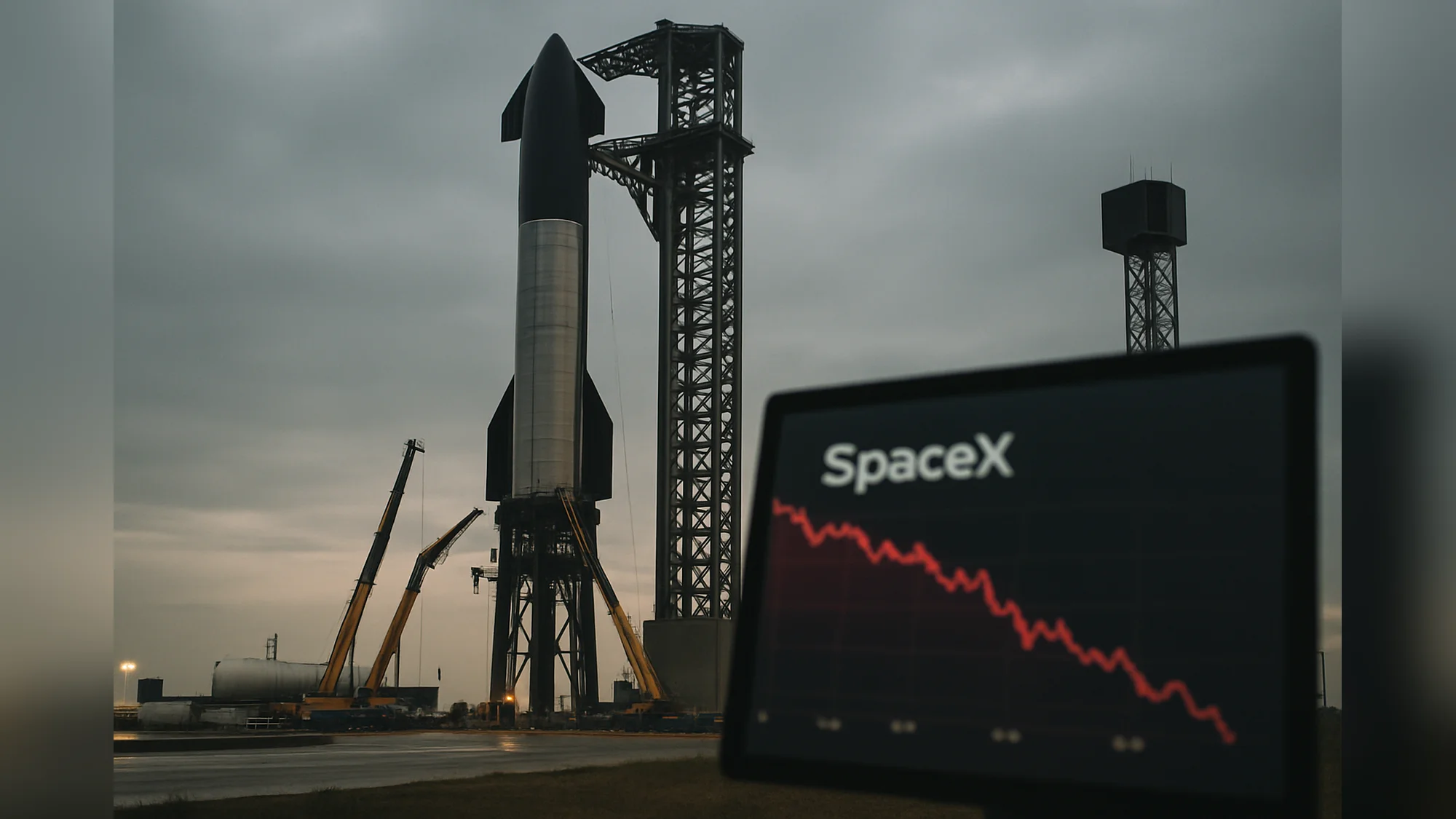
SpaceX shares closed at $131.11 on Thursday, slipping below the $135 IPO price for a second day after the company scrubbed a planned Starship test when several Raptor engines failed to start. The abort, visible on the company livestream and confirmed by CEO Elon Musk on X, knocked more than 3 percent off the stock and extended a multi-day selloff that began after last month's public offering, CNBC reported. Reuters calculated the abort and ensuing trading wiped roughly $100 billion of equity value in the short term. The company said crews will replace two engines and expects to try again in a few days, with one report putting a possible date at Monday, July 20.
The market consequence was immediate: investors lost ground as the automatic abort forced a halt to a high-profile test. CNBC reported Thursday's $131.11 close and said the stock had been on a five-day losing streak after a post-IPO rally. Reuters put the short-term equity erosion at about $100 billion. Short sellers also piled into the trade, with data from S3 Partners cited in trading coverage showing bearish bets swelled to roughly $25 billion and short interest rising to about 29 percent of the publicly tradable float.
The operational trigger was simple and stark. But SpaceX's live feed and Musk's posts on X said an automatic abort was triggered because some Raptor engines didn't start as the vehicle was lighting for liftoff from Starbase in South Texas. On the livestream a SpaceX employee described a hold on the Super Heavy booster that shut down engines as they were beginning to ignite. Reuters noted the abort came less than a second before the planned liftoff for the 13th flight test.
Musk wrote that two Raptor engines would be removed and replaced to ensure confidence in the next attempt, and that the company expected to try again in a few days. A SpaceX spokesperson on the livestream explained the hold and said teams began offloading propellant as they prepared to replace engines.
Posts from the director of Starship engineering and other engineers characterised the event as a first-time operation risk and a learning moment rather than a catastrophe.

The share-price drop landed on a newly public company that raised substantial sums in the offering, and the recent price action is testing investor appetite for a firm whose core products are still in intensive flight-test development. Trading coverage quoted industry investors who argued that day-to-day price swings don't change the long-term business case for Starship and Starlink, while other market participants warned the market is beginning to price the program's execution risk.
Regulation and past mishaps add texture to that risk. The Federal Aviation Administration investigated a prior flight in which a Super Heavy booster suffered propulsion failures and sank into the Gulf of Mexico. The FAA accepted SpaceX's corrective action plan and cleared Starship to resume flights before this latest attempt. CNBC reported that the FAA's mishap report identified heat effects on propulsion components and erroneous engine alarm settings as primary contributors to the earlier loss. SpaceX said it had implemented hardware and software changes after that anomaly.
The scrubbed mission also had programmatic consequences beyond the one-day market move. It was to be the first test of Starship Version 3 since the company listed, and the vehicle was scheduled to carry 20 next-generation Starlink satellites. SpaceX said those satellites were expected to extend their solar arrays and antennas after deployment and then reenter and demise roughly 20 minutes later. Industry investors view Starship as central to the firm's ability to scale Starlink, to pursue space-based data centres and commercial services, and to meet NASA ambitions for a crewed lunar lander.
For shareholders the question is whether such technical setbacks will translate into lasting valuation pressure. Short sellers have clearly placed that bet in size, according to the S3 Partners figures.
For longer horizon investors the calculus remains tied to execution: will SpaceX reduce failure modes quickly enough for Starship to deliver the payload and cost advantages the market expects? The company has signalled an aggressive repair pace, and Musk's posts suggested a next attempt could come within days if inspections and engine swaps go to plan.
Related Articles
- SpaceX IPO raises $75bn, market pegs value at $1.75tn
- SpaceX IPO deflates FOMO, space stocks tumble 40-50%
- Five join Nasdaq 100 as SpaceX IPO looms
SpaceX and Elon Musk said another launch attempt is most likely early next week, and one report said the vehicle could be readied as early as Monday, July 20 if engine swaps and inspections proceed on schedule. Reporting by CNBC and Reuters.
This article was created with AI assistance.


