
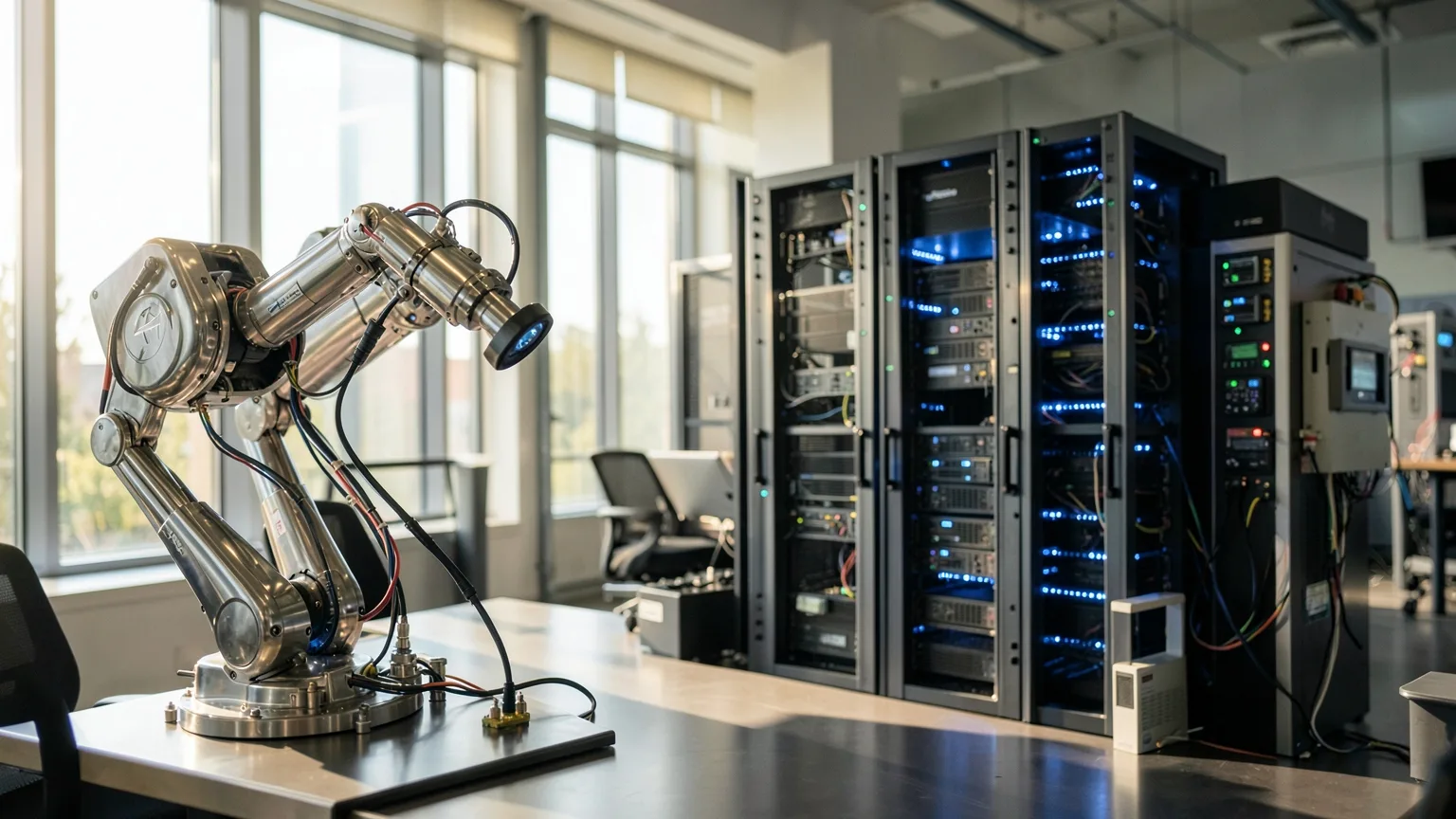
This week’s headline financings (Vinci’s US$250m Series B and Nvidia’s backing of Reactor) underline a surge of capital into deep-tech and “physical AI”, but the bets are concentrated, long-dated and hard to turn into liquid exits.
What investors mean by deep-tech and physical AI
Investors use deep-tech for startups whose edge comes from science and engineering rather than an app or an interface. These firms typically need laboratories, prototypes and years of development before they sell anything, and that long horizon attracts patient, specialist capital [www.globalbrandsmagazine.com].
Physical AI is artificial intelligence applied to machines and real-world environments: the software and models that let robots, vehicles and other devices sense, reason and act. Commentators often describe these systems as built around video-trained “world models” or specialised compute and simulation stacks [valueaddvc.com]. Investors draw rough category boundaries that include robotics, autonomous vehicles, aerospace, drones, industrial automation, sensors and chips, plus the compute and tooling that enable them. How much funding those categories total depends on which activities you count.
The investment picture: momentum, concentration and Ireland’s relevance
Vinci’s announcement of a Series B at a US$1.5 billion valuation this week is an example of the kind of large, infrastructure-oriented rounds now appearing in hardware-and-physics-focused businesses [www.businesswire.com]. Vinci sells an AI-native computational platform that brings fast, solver-accurate physics into design workflows: the sort of tooling investors see as reducing engineering lead times and making complex hardware projects more investable.
At the same time, media reports that Nvidia’s venture arm backed Reactor, which has taken its total funding to US$74 million to build cloud infrastructure to run video-based world models, point to a pick-and-shovels approach: back the infrastructure that will scale whichever model builders win market share. Those big rounds and acquisitions dominate aggregate totals; a handful of very large raises or exits can skew what looks like a broad surge.

Published global coverage does not include Ireland-specific market figures. Global headline numbers should not be treated as describing Irish deal activity without separate Irish data prepared for publication.
From seed to scale: what capital pays for and what investors test
Deep-tech firms typically move through long, capital-intensive stages. Early capital pays for research validation: lab work, reproducible experiments and prototype hardware. Later rounds fund pilot deployments, tooling to manufacture at scale, and the systems engineering needed to run physical products in the field. Vinci’s product narrative (moving fast from simulation to production-scale engineering programmes) shows why investors value tools that compress costly engineering cycles; faster, higher-fidelity design cuts the calendar time and cash a hardware company needs to reach manufacturable designs.
What investors test while capital is being deployed are practical, concrete things. For capital-intensive physical projects those tests include technical performance at the unit level and repeatable unit economics when products are made at scale. Investors also look for customer adoption in real pilots, supply-chain resilience and the ability to source components at the volumes required. Regulatory and safety readiness for real-world operation matters, and backers want a credible path to recurring revenue rather than one-off project sales.
For infrastructure plays that serve model builders, funders demand committed customers or anchor contracts that will generate the utilisation needed to make expensive compute stacks viable: the early economics of Reactor, for example, hinge on finding such anchors. Across stages, founders face a core trade-off between cash raised and ownership dilution: the more capital a company needs to reach manufacturable scale, the more rounds and dilution it typically faces, and it's a central strategic decision for teams.
Exit routes, outcomes and the realities behind headline valuations
Exits in deep-tech and physical AI often take two forms: strategic acquisition by larger industrial, semiconductor or software firms, and public listings by a narrow set of companies that reach scale and predictable revenue. Reports cited a US$8.2 billion acquisition of a world-model lab last month that dwarfs the modest totals of many infrastructure and early-stage players. Announced valuations and rounds (like Vinci’s US$1.5 billion valuation at Series B or Reactor’s US$74 million total funding) are milestones, not realised returns; large headline numbers can sit years ahead of liquidity for investors.
That gap matters. Deep-tech companies often need multiple follow-on financings to reach scaled revenue, and many never reach an exit that returns capital to early investors. Long timelines and significant failure rates are common, and capital is unevenly distributed: compute and semiconductor plays have tended to attract the largest cheques, while some scientific breakthroughs in areas such as advanced materials or quantum still struggle to find follow-on capital despite technical merit. Strategic partners, government grants and patient specialist funds are part of how many founders bridge the valley of death, but none of those routes guarantees a liquidity event.
What this week’s financings add up to
Taken together, the recent Vinci and Reactor financings show where investors are placing big, conditional bets: on tools that compress physics-driven engineering cycles, and on the compute and cloud layers that will serve video-and-simulation-heavy models for robots and vehicles. Those bets make tomorrow’s hardware projects easier to imagine and, potentially, cheaper to engineer, but they don't remove the basic facts of deep tech: long development, heavy capital needs, supply-chain and regulatory complexity, and exits that cluster in a few large outcomes. For Irish founders and investors, opportunities exist, but global headline figures should not be used as a proxy for domestic deal activity without separate Irish market data.


